Monday, 25 March 2013

Anatomy of a film: En cas de malheur

Always astute over financial matters and his reputation, Belgian writer Georges Simenon was acutely aware of the lucrativeness of cinema and its power in extending his readership. His novels were often adapted for cinema soon after publication - for instance, the years 1932 and 1933 saw the release of three films based on Maigret novels, all from 1931, the year of his big, 'bal anthropométrique' launch: La nuit du carrefour (directed by Jean Renoir), Le chien jaune and La tête d'un homme.

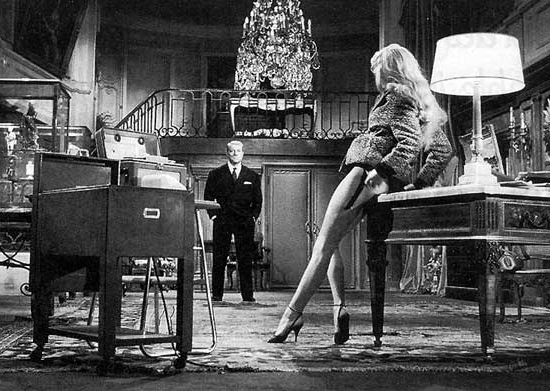
By the time Simenon's 1956 novel En cas de malheur was filmed, in 1958, 30 of the author's books had been adapted for cinema (only about a third of them Maigrets). Starring Jean Gabin opposite Brigitte Bardot, the film - whose title was translated as Love is My Profession - caused a stir for its nude scenes (pictured below), and is a good deal racier than another version 40 years later with Gérard Lanvin and Virginie Ledoyen, En plain coeur (In All Innocence), directed by Pierre Jolivet - Luc Besson's collaborator on Le dernier combat (1983).

Typically for one of Simenon's romans durs, En cas de malheur (In Case of Emergency) is written in the first person, as a married lawyer, maître Gobillot/Farnese, reflects on his affair with a young criminal; both films begin with the bungled jewellery store robbery that throws Yvette/Cecile (the names are updated for the more recent film) in his path. Aware she's about to be arrested for the crime, in both films Yvette pulls up her skirt to try to entice the lawyer to take her case (Bardot and Gabin, pictured top), though the scene is much more explicit in the book: 'She wore no pants. That was the first time I saw her thin thighs, her rounded childish belly, the dark triangle below it, and for no precise reason the blood rushed to my head.'

From then on, the 1958 film is surprisingly explicit: the first time he visits her, he comes too soon; once established in lodgings by Gobillot, Yvette institutes a ménage with her maid - a situation familiar from Simenon's own domestic life, where one maid is said to have asked another, 'On passe toutes à la casserole?' - both scenes are dropped in the 1998 version. (The maid in Claude Autant-Lara's original film is played by Nicole Berger, a beguiling presence who starred in an early Eric Rohmer short but died in a car crash aged only 32.) Yvette may be doing her best to keep Gobillot's interest alive, but there's surely also a hint of a lesbian aspect to her relationships with female accomplices and flatmates.

Jolivet's version is much less sophisticated than its predecessor: Gobillot's childlessness is highlighted in an awkward scene where his wife (Carole Bouquet) receives some adoption documents; and while Bouquet's role is more conventional, in the 1958 version, Edwige Feuillère portrays the same character as her husband's equal, who humours - even encourages - his affairs until they get out of hand. There's a lovely scene where Feuillère nevertheless hides her glasses quickly from her husband; one of that film's best images sees her flinging a giant bouquet of flowers meant for the mistress all over her husband's desk in the apartment that also serves as his office, a detail taken straight from the book. (The set up of their bedrooms, connected by a shared bathroom, is also pure Simenon.)

Where the 1998 film struggles most is in the portrayal of the lawyer: he is not supposed to be jealous when Yvette reignites an affair with someone of her own age - only Gabin can carry off Gobillot's knowing, stubborn insouciance. He's helped by some great lines and the 1958 film has some other nice touches, including the Middle Eastern music that blares in the miserable hotel where Yvette's young lover lives. The two films have completely opposing finales and yet, being Simenon, the outcome is the same - but only one ends with a haunting shot worthy of Casablanca's close.

Related: the lure of Psycho's opening scene

Monday, 18 March 2013

Dive! Dive! Dive! Sub movies

Film4 seems to have its submarine-movie jones on at the moment, so I thought I'd dig up and rework an old piece on the genre I did for Little White Lies' Marie Antoinette issue (Oct/Nov 2006).

'Dive! Dive! Dive!' Is there any more evocative word in cinema, especially when repeated three times? We all know what comes next: periscope down, the sonar's ping, red light reminiscent of a photographer's dark room. The submariner's life is one of numbers, too: distance to target, torpedo tube one, distance from the ocean surface, ever-rising pressure levels.

If you think about it, depth charges and silent routine have been imprinted on our minds through only a handful of films. One of the best is The Enemy Below, starring Robert Mitchum and Curt Jurgens - all the regulation words and images are present and correct.

There's the man who cracks amid it all - who can't take it any more - he even tries to climb up the conning tower and open the hatch when they're under water. He's talked down by captain Jurgens: 'It is part of our work to die; we are not going to die. Do you believe me? Do - you - believe - me?' He does.

There's a great shot just before this point in the movie: the crews are absolutely still in the middle of the Atlantic waiting for the tiny noise that gives the other away. One US soldier is shown playing noughts and crosses while another is fishing over the side of the boat. Audaciously, the camera travels all the way down his line to focus on the sub, paralysed on the seabed. Here, the German crew is playing chess.

Incidentally, it's no coincidence sci-fi movies share much with submarine movies - that slim metal tube floats precariously in an alien environment. In the same way a U-boat's hull might give way - fatally - at any moment, so, 'The engines cannae take it, Cap'n.'

Geoff Dyer, whose Zona, about Tarkovsky's Stalker, is out now in paperback, itemises the distinctive tropes of the submarine movies in his memorable 1998 e-novel Paris Trance ('e', in those days, for ecstasy). Characters Luke and Alex pore through the pages of listings mag Pariscope for the best way to experience the city of (flickering) light, only to discover they're surrounded by Cassavetes films.

So these movie buffs escape instead in a love of submarine films. Their list of themes fills a page of the book (p33 in the Abacus paperback edition, if you happen to have one to hand), and they come to one vital conclusion: 'Essentially you're a Second World War man?' 'Through and through.' No Crimson Tide or The Hunt for Red October for them.

Made in 1957, The Enemy Below exemplifies what makes this genre so special: it's not the rakish fashions, the thrill of the chase or the heightened sense of claustrophobia - no, it's because these films consistently humanise the enemy. Like no other, the WWII sub flick is as interested in the other side as the heroes we're ostensibly backing. Could this be because the two sides are at different levels? This literally isn't a level playing field.

As captain Jack Hawkins tells his deputy after a gruelling chase in The Cruel Sea (1953) : 'Number One, this is quite a moment: we've never seen the enemy before... They don't look very different from us.'

Director Wolfgang Peterson extended the form for his groundbreaking 1981 TV series, Das Boot. Here we see the war entirely from the point of view of the German crew; as in The Enemy Below, a young Nazi ideologue onboard is humoured like a wilful child: wrongheaded, but what can you do? Here again is the captain portrayed as mythical seer, a man whose experience and guile will see his men home alive.

This is the best bit: the Second World War submarine film is visceral Battleships, a bloody mind game played out, usually by two mutually admiring leaders. As Jurgen Prochnow's captain declares at a crucial moment in Das Boot: 'Jetzt wird es psychologisch, meine Herren' - 'This is where it gets psychological, gentlemen.'

Submarine movies Operation Petticoat and The Bedford Incident screen on Film4 in the UK this afternoon from 1.20pm. Painting 'Torpedo... Los!' by Roy Lichtenstein can be seen in Tate Modern's retrospective of the US pop artist, which runs until 27 May.

Monday, 11 March 2013

Soho Crime around the world

I'm a huge fan of New York publisher Soho Crime's output - particularly the translated fiction. Their catalogue covers detective thrillers from Japan to Norway. Here are some of the picks - dates are for original (foreign-language, where appropriate) publication:

Cara Black - PARIS
American author Cara Black is as impressively prolific as Janwillem van de Wetering (below) - her Aimée Leduc is a half-French, half-American private detective who throws herself into her cases, alongside dwarf, computer expert sidekick René Friant. The novels travel the arrondissements of Paris, imbuing each book with the atmosphere of the individual districts. 
WHAT THEY SAY 'Murder in the Marais provides a richly textured journey into the dark side of the City of Light.' - Linda Grant
CHECK OUT Murder in the Marais (1999)

Akimitsu Takagi - TOKYO
Another excellent translation - by Deborah Boehm - which brings Akimitsu Takagi's traumatic The Tattoo Murder Case (1948) up to date. Set in the aftermath of Japan's loss in the WWII and the destruction of atomic bombs on Hiroshima and Nagasaki, a trio of detectives try to crack a case of tattoo theft. Do also try Seichi Matsumoto's excellent Inspector Imanishi Investigates (1961)
WHAT THEY SAY 'Clever, kinky, highly entertaining...' Washington Post on The Tattoo Murder Case
CHECK OUT The Tattoo Murder Case

Helene Tursten - GÖTEBORG
Helene Tursten's Inspector Irene Huss is a judo-practising cop to rival Sarah Lund in a series of procedurals that marches in the steps of Swedish innovators Maj Sjöwall and Per Wahlöö.
WHAT THEY SAY 'Huss is quickly becoming one of the most satisfying lead characters in the thriving world of Swedish crime fiction.' - Booklist
CHECK OUT Detective Inspector Huss (1998)

Janwillem van de Wetering - AMSTERDAM and beyond
Dutch Zen-adherent Janwillem van de Wetering's many mysteries feature police duo Grijpstra and De Gier, as well as their boss, the Commisaris. The books present a thoughtful view of Dutch policing and venture further afield - to New York, Japan and one-time Dutch colonies, including Aruba and Curaçao. Questioning and even mystical.
WHAT THEY SAY 'He is doing what Simenon might have done if Albert Camus had sublet his skull.' - John Leonard
CHECK OUT Outsider in Amsterdam (1975), The Japanese Corpse (1977) and The Streetbird (1983)

Wednesday, 13 February 2013

Happy 110th birthday, Georges!

This year marks the 110th anniversary of the birth of one of Liège's most famous sons, author Georges Simenon. What better way to pay homage than a short walk around the major sites of his young life in the southern Belgian city.

Start at 24 (formerly 26) rue Léopold, where Georges was born on a rainy night. He is famously said to have been born on Friday the 13th, 1903, but his superstitious mother insisted that his father register the date of birth as the 12th.

On the wall in front of the nearby Hôtel de Ville, on the Place du Marché, check out the memorial plaque to Commissaire Arnold Maigret, whose surname may have been appropriated for Simenon's greatest creation: Chief Inspector Jules... Simenon will no doubt have been aware of the real Maigret when he started work as a young reporter on the Gazette de Liège newspaper.

From here cross over to quirky Outremeuse, over the Pont des Arches - the title of Simenon's first novel - via the Eglise St-Pholien, which became the inspiration for another early book when his friend Kleine was found hanged from the front door.

Behind the St-Pholien church, on Impasse de la Houpe, the infamous group La Caque ('the keg') - named for its cramped circumstances - hung out, indulging in drink, drugs and sex. I'm tickled by the pride the town takes in Simenon's experience on rue Capitaine, where the man who later claimed to have bedded 10,000 women handed over a watch he had been given by his father to sleep with a prostitute.

The island of Outremeuse has a strange, otherworldly reputation in Liège's folklore and the family moved here a year after Georges was born. The atmosphere of the house in the rue de la Loi, next door to Georges's school, permeates much of Simenon's work, from the autobiographical Pedigree to one of the most famous romans dursStain in the Snow.

If you continue to the place du Congrès, you'll spot a bust of Simenon, not far from the Chapelle de Bavière, where young Georges served as an altar boy. He would have to leave home at 5.45am, arriving out of breath as he ran, frightened, all the way in the dark.

Running away is the a central theme of all Simenon's work and he, too, left the city, following the deaths of his father and Joseph Kleine. On 10 December 1922 he took the night train to Paris, the city where he would plot his fame and fortune.

You can hire an audioguide to Simenon's Liège for €4.50 at the local tourist office, which also provides a map of the route.

Related post: Simenon's Paris

Wednesday, 2 January 2013

Milady at the National Portrait Gallery

Last summer, London's National Portrait Gallery bought its first painting of a man in women's clothes. The painting shows Chevalier d'Eon, Louis XV's secret envoy to Russia and England, dressed as a woman. Accused by his enemies of being a hermaphrodite, he may have served as inspiration for the character of Lady de Winter in The Three Musketeers.

In his coy introduction to his translation of Alexandre Dumas' classic, Lord Sudley tackles the mystery of Milady, "who is referred to by all the men as 'the vampire', the 'creature from Hell', the 'monster', the 'woman who is not a woman'..." It is perhaps this last nomenclature that is the most telling.

"All men who come her way are first fascinated and then repelled by her, and in the end the terror she inspires in them is, as it were, the terror of the supernatural." Branded with the fleur-de-lis for a youthful crime, "Only her husbands (she had two) and her lovers find out her 'secret', and for that, she declares they must die... Might not Dumas, in creating such a character, have intended to convey that Milady had that particular form of physical malformation which was regarded even in the 16th and 17th centuries as a terrifying token of divine displeasure, punishable by death - a malformation of which the fleur-de-lis was merely a symbol?"

Monday, 17 December 2012

Paris posers

I meant to take Penguin's reprint of Julian Green's Paris with me to the French capital but, in a moment worthy of Geoff Dyer in Out of Sheer Rage, forgot it at home. So I visited Green's impressions of the city of his birth while on the London Underground instead.

Like the author on his return to the USA during World War II, 'It was a Paris of visions in which I took my walks now, a Paris that, though intensely real, was imperceptibly migrating from flesh to spirit.' In her idiosyncratic yet incisive introduction, Lila Azam Zanganeh rightly challenges Green's nostalgia and even his tendency to exclude others from experiencing 'the Paris of the Parisians'.

In my favourite chapter, 'Museums, streets, seasons, faces', Green contends: 'The posers you could set, even for teachers, just by running through the history of our city (what happened to the mummies brought back from Egypt, where were they buried, what lies beneath the column on which the spirit of the Bastille is forever taking wing, where did they divert the Phantom of the Opera's underground lake, who posed for the statue of Pierre de Wissant, who lived in the château des Brouillards?), but in Paris you may always be sure there will be someone, secretly in love with his city, who will know all the answers.' That must be true of London nowadays, too.

(The answers to Green's posers can be found at the back of the Penguin Modern Classics Paris.)