Earlier this year Dutch publisher Parvenu released an English catalogue of the work of Marianne Breslauer. Originally published in 2009 to celebrate the 100th anniversary of the German photographer's birth, Marianne Breslauer - Photographs focuses on nine years of serene work from 1927 to 1936.
At the age of 20, Breslauer went to Paris to study photography under Man Ray who decides she has nothing to learn from him but extends her the use of his studio. In photographing the banks of the Seine and the Jardin du Luxembourg, she inevitably invokes Jacques Henri Lartigue (there's also something of his albums here), Ilse Bing, ubiquitous Atget and, of course, Henri Cartier-Bresson.
Her work tends to series: best of all is a set taken at an art auction, Vente S&S, attended by Pablo Picasso and Ambroise Vollard, among others. The spirit of two shots of Berlin's Lützowbrücke (1930) is revisited from 1932-36 when Breslauer photographs the same Amsterdam canal: two shots have the same laundry hanging on the same boat with the same car parked alongside (there's even a reverse shot from the canal side, though this time it's a different boat decorated with different laundry).
Circus, Berlin 1931 is a series of six pictures of the same androgynous child; a year later, writer and photographer Annemarie Schwarzenbach is similarly androgynous in two striking portraits. The portraits become increasingly mature, from the cover shot (Ruth von Morgen, Berlin 1934, pictured) to delicate images of Oskar Kokoschka and Albert Barnes, but the key to her oeuvre must be the self-portraits.
In an essay, Marion Beckers and Elisabeth Moortgat make a great deal of a 1929 image the photographer took of herself, looking askance, hair pulled over one eye. In 1933 she is naked in a dressing gown and again not looking at the viewer but into her camera, which looks out at us (and at her). She is the only nude in the book in a manner reminiscent of another young prodigy, Francesca Woodman - in such short careers, the catalogue of both inevitably leans on student work.
The changing situation in Europe notwithstanding, Breslauer seems to have felt she had exhausted all she could achieve as a photographer and laid down her camera some time around 1937. 'If I had worked longer in this area, I would have gone into film,' she said. 'I'd had enough of photography.' The final snaps here date from 1938, and there's Breslauer, again in her housecoat, partially exposed, but bearing her camera.
Showing posts with label André Kertész. Show all posts
Monday, 7 May 2012
Monday, 12 September 2011
'You have to be Hungarian'

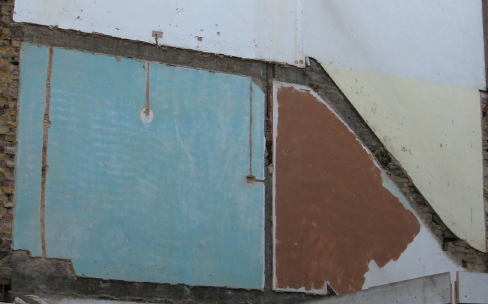
I've always had a certain fascination for the exposed insides of demolished buildings (pictured below). This is due to the revelation of secret spaces, as well as the abstract patterns they create (above). It took a photograph by André Kertész, however, to show me how to capture these sites properly. In Landing Pigeon (New York, 1960), which features in Eyewitness: Hungarian Photography in the Twentieth Century, he sets off the angles of vanished stairways with a bird in flight.
The Royal Academy's show concentrates on five big names: Brassaï, Robert Capa, Kertész, Lászlo Moholy-Nagy and Martin Munkácsi. You sense the curators have tried their damnedest to draw themes from the displayed work, though they struggle to explain Capa's joshing maxim, 'It's not enough to have talent, you also have to be Hungarian.' This is especially so when for much of the period under review, photography was severely restricted in Hungary, leading most of the names here to practise their art abroad - how to separate Brassaï from his views of Paris or vice versa?
Opening with a folkloric vision, notably espoused by Rudolf Balogh, the exhibition comes full circle in Miklós Rév's Straight Road (Inota, c1955), which pitches a rural idyll against industrial reality. (Tibor Schoen's Ravens - Az Erdekes Ujság, 1915 - is another picture of two halves: a dead soldier in a Christmas card scene.) There's a predictable cavil: the most recent work here is from 1992 - a shame the Royal Academy didn't throw open one of its free rooms to bring the story up to date.
Eyewitness runs until 2 October and the bumper catalogue is now only £14.95.
Labels:
André Kertész,
art,
Hungary,
photography,
Royal Academy
Wednesday, 24 November 2010
Book-photography photography books
The earliest photograph in André Kertész's On Reading features barefoot Hungarian children poring over a book in 1915. The collection, first published in 1971, features readers in the important locations of the Hungarian-born photographer's life: Paris, New York, Argentina, where his younger brother emigrated. There are groups of students, presumably, sitting with books in NYC's Washington Square, otherwise many of those captured by Kertész are reading newspapers. The best images are of isolated book-lovers caught surreptitiously on rooftops. Reading is a solitary pleasure and here people have found their own undisturbed space, until Kertész's lens comes snooping.
A friend takes beautiful pictures of people reading. As with Kertész, the book cover is generally obscured but the books lend their titles to the photographs; while these are portraits of people, you can be in no doubt what the subject is. I would have liked to have been photographed on the blue bench outside my old flat, where I could sit on summer evenings. Now it would have to be on my daily commute, when I do the majority of my reading. I'm not sure what I'd be holding, something by Simenon, no doubt. (The pictures accompanying this post are my own, of Shakespeare and Company in Paris.)
In 2002, Cuban-born Abelardo Morrell (famous for his camera obscura images) published a book of photographs of books, A Book of Books. It's not an obvious project but apparently some of the first pictures taken by photographic pioneer Henry Fox Talbot were of his library. Morrell's photos feature some tomes that have been altered, for instance by having a hole drilled in one, though I'm especially drawn to his image of an edition of A Tale of Two Cities, where the print of the reverse side of the page is coming through. Giant storage spaces work well, too, reminiscent of Alain Resnais' 1956 short film about Paris's Bibliotheque Nationale, Toute la mémoire du monde. And then there are heartbreaking images of books damaged by dirt or irreversibly warped by water. Tragic.
A friend takes beautiful pictures of people reading. As with Kertész, the book cover is generally obscured but the books lend their titles to the photographs; while these are portraits of people, you can be in no doubt what the subject is. I would have liked to have been photographed on the blue bench outside my old flat, where I could sit on summer evenings. Now it would have to be on my daily commute, when I do the majority of my reading. I'm not sure what I'd be holding, something by Simenon, no doubt. (The pictures accompanying this post are my own, of Shakespeare and Company in Paris.)
In 2002, Cuban-born Abelardo Morrell (famous for his camera obscura images) published a book of photographs of books, A Book of Books. It's not an obvious project but apparently some of the first pictures taken by photographic pioneer Henry Fox Talbot were of his library. Morrell's photos feature some tomes that have been altered, for instance by having a hole drilled in one, though I'm especially drawn to his image of an edition of A Tale of Two Cities, where the print of the reverse side of the page is coming through. Giant storage spaces work well, too, reminiscent of Alain Resnais' 1956 short film about Paris's Bibliotheque Nationale, Toute la mémoire du monde. And then there are heartbreaking images of books damaged by dirt or irreversibly warped by water. Tragic.
Subscribe to:
Posts (Atom)