
Showing posts with label film. Show all posts
Showing posts with label film. Show all posts
Thursday, 7 March 2019
New from the BFI


Friday, 23 May 2014
The Maigret Circle

One of the prolific author's non-Maigret, romans durs, The Mahé Circle (cover image above) is an intriguing addition to Simenon's translated catalogue, in which the good Dr Mahé is trapped in a bleak infatuation on his recurring family holiday in Porquerolles - the island off the Côte d'Azur and the setting for My Friend Maigret (1949), one of the dozen or so books featured in Penguin's previous, apparently ill-fated Simenon revival back in 2003. A little down the coast, the Cannes Film Festival has hosted the premiere of Mathieu Amalric's intriguing adaptation of The Blue Room (1955), starring the actor-director alongside Stéphanie Cléau and Léa Drucker (here's the poster).
No doubt all this and more will be mulled over by biographers Pierre Assouline and Patrick Marnham when they share the stage at the Institut Français on 1 June. Their discussion follows a screening of one of my favourite Simenon adaptations, M Hire, as part of the Institut's all too short Noir is the Colour season.
Tuesday, 2 July 2013
Winter of Discontent and Tahrir Square

Cairo’s Tahrir Square is the focus of
protest in Egypt just as it was over two years ago. On 10 February 2011 a film crew led
by director Ibrahim El Batout and featuring Egyptian actors Amr Waked (pictured) and Farah
Youssef began filming among the protestors. The scene they shot imagined the
fall of Mubarak – the next day the president resigned.
The material became the climax of Winter of
Discontent, which screens at the Ciné Lumière on Wednesday 3 July as part of the Shubbak Festival.
It screened at the same venue in the London Film Festival 2012, when I
met Waked. Known internationally for roles in Syriana and Salmon Fishing in
Yemen, he told me about filming Winter of Discontent amid the protests…
'I got involved from the very first day of
the pitch. It was a very spontaneous reaction, the director, Ibrahim El Batout,
called me and asked me if I wanted to do something about what was happening in
Egypt.
'I had been on the square every day. You felt
that whatever function we played as people who are known to encourage people to
take to the streets and not fear was already done, and if I leave the square
and start doing something I think the square will stay alive. I thought it was
time to do something we know best, which is make a film.
'I went and met him the same day with
cameras and sound, and I called a DOP friend of mine who filmed the film. We
all met in the square thinking the guy wants to do a documentary about
what’s happening, and we find an actress with him and then he pitches the
story. It was very vague, it wasn’t as developed as the film is.
'The director sat with the writers, and they
came out with a brief structure on how the film would develop and how the
dramatic progression would go. It was almost 12 pages, which we didn’t want to
develop further because what we had shot before was purely improvised so we
wanted to keep that sense of improvisation in the whole film and we did.
'The performances in the film – I’m not
talking about mine, of course, I’m talking about everybody else – the smallest
shot of an actor saying the tiniest thing is so powerful and so real. That’s a
very different quality in Arabic films of today to find this guy who comes in
and out of the scene for a few seconds. They’re usually not very well rooted
and you feel somehow they choose them like that so the star would shine but we
don’t have that in our film, everybody shines.
'That was very powerful and it’s very
difficult to think how we can do that again because we had so much energy
from the square and what was happening, which was enormous. I hope we can find
that energy in other topics.'
Thursday, 28 March 2013
The long films' Good Friday

During my university finals I stayed in every Saturday night, but not because I was swotting for my exams. For 13 weeks, in a quietened house, I sat in front of the television for the second part of Edgar Reitz's Heimat chronicle - all 25-and-a-half hours of it. On its Munich premiere, in 1992, it broke the record for the longest film ever screened commercially. And that’s after the first Heimat (pictured), which was also broadcast on BBC2, came in over 15 hours long.
You’ll have guessed that for me, length
does matter. Some films are long because of the tradition they come from - Bollywood in the case of popular crossover film, Lagaan (2001), which is nearly
as long as the cricket match at its centre - or their source, although in the
case of Sergei Bondarchuk's eight-hour War and Peace (1967), reading the book
might be quicker. L
The master of the extended film is French
director Jacques Rivette. His 1961 début, Paris Nous Appartient (1961), a tale
of paranoia among avant-garde types that plays like a zombie flick for
intellectuals, is 140 minutes long. By 1971 he hit the big time, literally: Out
One runs to 12 hours, cut to a relatively prolix three-and-a-quarter hours in 1974. The same year's Céline and
Julie Go Boating positively fizzes along and is the
unlikely inspiration for Susan Seidelman’s Desperately Seeking Susan (1985).

Rivette's La Belle Noiseuse (pictured, 1991) is a
ravishing portrait of the relationship between the artist and his muse. For
pretty much four hours you get to stare at a naked Emmanuelle Béart. It's
certainly one of her best roles, as it makes the most of her incredible beauty
and a steely, defensive, character beneath. Michel Piccoli is the artist with
whom she shares this watchful dance; the passions may be muted but what emerges
on screen is absolutely devastating. And this is the glory of long films: to
get as much under the skin of something as you ever can; this is cinema where
viewers are afforded space to think.
In Beyond the Hills, currently showing in
cinemas, Romanian director Cristian Mungiu builds up a claustrophobic picture
of life at an isolated, orthodox monastery using repetition and long takes. Hungarian director Béla Tarr is celebrated for
his long takes: for the first 17 minutes of his seven-hour magnum opus, Sátántangó (1994), you don't see a human face - only a group of cows in a farmyard.
It's an opening that could be said to be reflected in Mexican director Carlos Reygadas' wonderful Post Tenebras Lux - 25 scenes over two hours, and a dog called Bela, coincidentally.
None of these directors expects you to watch without a break, as attested by screenings of Lawrence of Arabia (1962) - late last year at the BFI Southbank - or four and a half hours of Rauol Ruiz' The Mysteries of Lisbon (2010) - at the Curzon Soho. I watched Beyond the Hills and Post Tenebras Lux at London's Renoir cinema, in the Brunswick Centre, the same place I saw a revival of Jean Eustache's three-and-a-half hour The Mother and the Whore (1973) a generation ago. The Renoir also hosted the final part - thus far - of Edgar Reitz’ Heimat trilogy.
None of these directors expects you to watch without a break, as attested by screenings of Lawrence of Arabia (1962) - late last year at the BFI Southbank - or four and a half hours of Rauol Ruiz' The Mysteries of Lisbon (2010) - at the Curzon Soho. I watched Beyond the Hills and Post Tenebras Lux at London's Renoir cinema, in the Brunswick Centre, the same place I saw a revival of Jean Eustache's three-and-a-half hour The Mother and the Whore (1973) a generation ago. The Renoir also hosted the final part - thus far - of Edgar Reitz’ Heimat trilogy.
Heimat (1984) is a tightly
controlled family drama spanning Germany's 20th-century experience set in the
north-Rhein region of Germany: the Hunsrück. Eight years later, Reitz turned to
the youngest son of the clan’s university years in 1960s Munich; the memories of
friendships and adventures are so strong that I’m sure they’ve even replaced
some of my own student time.
 Like Wolfgang Petersen's five-hour - in its uncut version - Das Boot (pictured, 1981) and contemporary Italian family drama The Best of Youth (six hours), which won the Un Certain Regard Award at Cannes in 2003, Heimat was made for TV - as was Lars von Trier's brilliant, lengthy hospital-set spooker, The Kingdom (1994) and Rainer Werner Fassbinder's 15-and-a-half Berlin Alexanderplatz (1980), adapted from the book by Alfred Döblin.

In 2004, Reitz felt there was
enough left to explore in his overarching theme of belonging to make the whole
a trilogy. Heimat 3 - six full-length features - begins with the fall of the
Wall but is strangely depressing, perhaps mirroring the writer-director's difficulties in
getting it made. 'It took five years of fighting for the funding,' he told me
at the time, 'and now it probably wouldn’t work at all.'
Despite this pessimism, Reitz is said to be
working on a fourth instalment in the Hunsrück, but what he has
already achieved has left an indelible mark: these places, faces, even accents will stay
with you forever. It is already over 52 hours long - or an hour a
week for a year. That’s as much as I do yoga. Mind you, I could do with a
stretch now.
Related post: diving into submarine movies
Related post: diving into submarine movies
Monday, 25 March 2013
Anatomy of a film: En cas de malheur
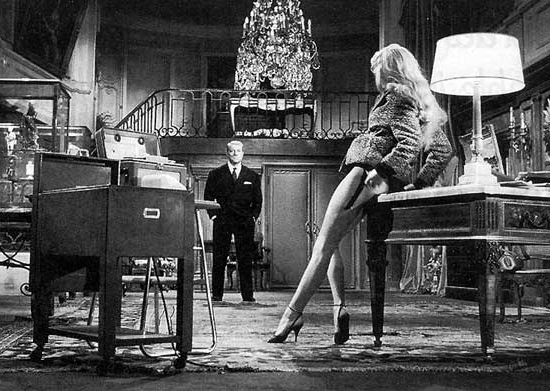
By the time Simenon's 1956 novel En cas de malheur was filmed, in 1958, 30 of the author's books had been adapted for cinema (only about a third of them Maigrets). Starring Jean Gabin opposite Brigitte Bardot, the film - whose title was translated as Love is My Profession - caused a stir for its nude scenes (pictured below), and is a good deal racier than another version 40 years later with Gérard Lanvin and Virginie Ledoyen, En plain coeur (In All Innocence), directed by Pierre Jolivet - Luc Besson's collaborator on Le dernier combat (1983).

From then on, the 1958 film is surprisingly explicit: the first time he visits her, he comes too soon; once established in lodgings by Gobillot, Yvette institutes a ménage with her maid - a situation familiar from Simenon's own domestic life, where one maid is said to have asked another, 'On passe toutes à la casserole?' - both scenes are dropped in the 1998 version. (The maid in Claude Autant-Lara's original film is played by Nicole Berger, a beguiling presence who starred in an early Eric Rohmer short but died in a car crash aged only 32.) Yvette may be doing her best to keep Gobillot's interest alive, but there's surely also a hint of a lesbian aspect to her relationships with female accomplices and flatmates.
Jolivet's version is much less sophisticated than its predecessor: Gobillot's childlessness is highlighted in an awkward scene where his wife (Carole Bouquet) receives some adoption documents; and while Bouquet's role is more conventional, in the 1958 version, Edwige Feuillère portrays the same character as her husband's equal, who humours - even encourages - his affairs until they get out of hand. There's a lovely scene where Feuillère nevertheless hides her glasses quickly from her husband; one of that film's best images sees her flinging a giant bouquet of flowers meant for the mistress all over her husband's desk in the apartment that also serves as his office, a detail taken straight from the book. (The set up of their bedrooms, connected by a shared bathroom, is also pure Simenon.)
Where the 1998 film struggles most is in the portrayal of the lawyer: he is not supposed to be jealous when Yvette reignites an affair with someone of her own age - only Gabin can carry off Gobillot's knowing, stubborn insouciance. He's helped by some great lines and the 1958 film has some other nice touches, including the Middle Eastern music that blares in the miserable hotel where Yvette's young lover lives. The two films have completely opposing finales and yet, being Simenon, the outcome is the same - but only one ends with a haunting shot worthy of Casablanca's close.
Related: the lure of Psycho's opening scene
Monday, 18 March 2013
Dive! Dive! Dive! Sub movies

'Dive! Dive! Dive!' Is there any more evocative word in cinema, especially when repeated three times? We all know what comes next: periscope down, the sonar's ping, red light reminiscent of a photographer's dark room. The submariner's life is one of numbers, too: distance to target, torpedo tube one, distance from the ocean surface, ever-rising pressure levels.
If you think about it, depth charges and silent routine have been imprinted on our minds through only a handful of films. One of the best is The Enemy Below, starring Robert Mitchum and Curt Jurgens - all the regulation words and images are present and correct.
There's the man who cracks amid it all - who can't take it any more - he even tries to climb up the conning tower and open the hatch when they're under water. He's talked down by captain Jurgens: 'It is part of our work to die; we are not going to die. Do you believe me? Do - you - believe - me?' He does.
There's a great shot just before this point in the movie: the crews are absolutely still in the middle of the Atlantic waiting for the tiny noise that gives the other away. One US soldier is shown playing noughts and crosses while another is fishing over the side of the boat. Audaciously, the camera travels all the way down his line to focus on the sub, paralysed on the seabed. Here, the German crew is playing chess.
Incidentally, it's no coincidence sci-fi movies share much with submarine movies - that slim metal tube floats precariously in an alien environment. In the same way a U-boat's hull might give way - fatally - at any moment, so, 'The engines cannae take it, Cap'n.'
Geoff Dyer, whose Zona, about Tarkovsky's Stalker, is out now in paperback, itemises the distinctive tropes of the submarine movies in his memorable 1998 e-novel Paris Trance ('e', in those days, for ecstasy). Characters Luke and Alex pore through the pages of listings mag Pariscope for the best way to experience the city of (flickering) light, only to discover they're surrounded by Cassavetes films.
Made in 1957, The Enemy Below exemplifies what makes this genre so special: it's not the rakish fashions, the thrill of the chase or the heightened sense of claustrophobia - no, it's because these films consistently humanise the enemy. Like no other, the WWII sub flick is as interested in the other side as the heroes we're ostensibly backing. Could this be because the two sides are at different levels? This literally isn't a level playing field.
As captain Jack Hawkins tells his deputy after a gruelling chase in The Cruel Sea (1953) : 'Number One, this is quite a moment: we've never seen the enemy before... They don't look very different from us.'
Director Wolfgang Peterson extended the form for his groundbreaking 1981 TV series, Das Boot. Here we see the war entirely from the point of view of the German crew; as in The Enemy Below, a young Nazi ideologue onboard is humoured like a wilful child: wrongheaded, but what can you do? Here again is the captain portrayed as mythical seer, a man whose experience and guile will see his men home alive.
This is the best bit: the Second World War submarine film is visceral Battleships, a bloody mind game played out, usually by two mutually admiring leaders. As Jurgen Prochnow's captain declares at a crucial moment in Das Boot: 'Jetzt wird es psychologisch, meine Herren' - 'This is where it gets psychological, gentlemen.'
Submarine movies Operation Petticoat and The Bedford Incident screen on Film4 in the UK this afternoon from 1.20pm. Painting 'Torpedo... Los!' by Roy Lichtenstein can be seen in Tate Modern's retrospective of the US pop artist, which runs until 27 May.
Monday, 16 July 2012
Leos Carax' work in five easy steps

2. Carax favourite Denis Lavant
thankfully has less to say in the stand-out, futuristic crime caper Mauvais
Sang (The Night is Young, 1986), when he joins Michel Piccoli’s gang, out to
steal a vaccine to the ‘STBO retrovirus’.
3. Both films are luminously shot – by
Jean-Yves Escoffier (Gummo) – whose final collaboration with Carax is the
director’s magnificent folly, Les Amants du Pont Neuf (1991) featuring a
hallucinatory affair between homeless Lavant and Juliette Binoche.
4. By the
time of Pola X (1999) Carax may be trying to buck his influences much as gilded
author Guillaume Depardieu decides to throw off his privileged background. The
result, for all concerned, is exceedingly tiresome and deeply unedifying.
5.
After a hiatus of 13 years - interrupted only by a short for Tokyo! (2008) -
Carax' latest, Holy Motors (pictured top), received its premiere at
Cannes earlier this year. The film sees the director tackle his fascination
with cinema and reunites him with Lavant and Piccoli, plus Eva Mendes and, erm,
Kylie Minogue.
The 65th Festival del film Locarno kicks off on 1 August and features a retrospective dedicated to Leos Carax, who'll be in Switzerland to accept the
festival's Pardo d'onore. I'd love to go but will be busy with a thing in
London, which may also mean this is my last post for a few weeks.
Monday, 9 July 2012
Alfred Hitchcock: the early years
However exciting the chance to see many of
Alfred Hitchcock’s silent movies with new scores in the BFI’s splendid summer season dedicated to the director, it’s telling how the burgeoning of his
cinematic art coincided with the arrival of sound. Early silent stand-outs include The
Lodger (1926), now soundtracked by Nitin Sawhney - live at the Barbican on 21 July - and The Ring (1927), an
expressionistic romance set in the world of sideshow boxing that screens at Hackney Empire this Friday.
Key for me is 1929’s Blackmail, a superb
thriller in which Hitchcock shows his immediate mastery of the new talking
technology (he even uses silence to great effect!). He steps up the confident
rhythm of the preceding films and continues to experiment with his visuals;
there’s an early signatory cameo – being attacked by a child in a tube carriage
– plus a tumultuous chase after the blackmailer of the title in the British
Museum onto the roof of the reading room. (Blackmail screened at the British Museum on Friday.)
If you want to check out some other lesser-known (talkie) numbers, the trademark spectacular finales continue
in courtroom drama Murder! (1930), while another film based on a play, The Skin Game (1931),
is the cruel tale of landed gentry taking on nouveau incomers that is still as
surprisingly successful as when it was released. The same year's Rich and Strange is a curio, a
self-scripted tale of a childless couple’s disastrous global travels, while
Number 17 (1932) is a ludicrous splurge containing all the clichés of the thriller
genre: stolen jewels, double-crossing thieves, confused identity, runaway
trains, a hijacked bus and – a favourite of the director – trussed up heroines.
Courtesy of Hitchcock’s pre-eminent position in the industry the early films
boast great scenery and lavish sets but it’s with sound he realised thrillers
were his thing and, just as importantly, discovered the perversity – both
morally and in terms of his little fetishes – that mark his particular genius.
Monday, 18 June 2012
Hitchcock's favourite: Shadow of a Doubt
Inspired by the Guardian's My favourite Hitchcock series - and eschewing biggies Psycho, Vertigo and North by Northwest - I thought I'd throw Shadow of a Doubt (1943) into the ring. It's a remarkable psycho-sexual drama, not least because we're some way in before the director makes explicit what's going on: beloved Uncle Charlie (Joseph Cotten) has gone to stay with his sister and her family in Santa Rosa to escape the police, who are hunting a killer dubbed the 'Merry Widow murderer' for his habit of befriending and killing wealthy women.
Hitchcock is a master of the everyday-man wrongly suspected of a crime scenario, but here we're looking for clues that Charlie's a wrong 'un. Quick to pick up the trail is his adoring niece, played by Teresa Wright, who's so close to her uncle she's known as 'young Charlie'; she even believes there's an extrasensory link between them and he's come to town precisely because he sensed she was bored.
Young Charlie's sharper than the rest of her family - including dad, who discusses amateur criminology with his neighbour, a young Hume Cronyn, and is taken in by the gift of a watch - but also smitten with her uncle. The interest is reciprocated, but it's only when one of the detectives falls for her that the case begins to fall into place - when Uncle Charlie gives his niece a stolen ring in a cod wedding scene.
Much is made of the film's small-town setting - Thornton Wilder worked on the script - but I particularly like the opening scenes in Philadelphia, which so cleverly set up Uncle Charlie's character, and are filled with rundown fire escapes and desolate city streets that presage the start of Psycho seven years later.
Best of all is the sense of restrained, almost insouciant, menace in Cotten's performance. This was a year or two after Orson Welles had cast the stage actor - and one-time theatre critic - in Citizen Kane (1941). Cotten made his name as a romantic lead but this is one of his most compelling performances - his slyness contrasts nicely with the character he was to take on in Welles's The Third Man (1949).
When he's found out, Hitchcock even gives Cotten a speech to match Welles's famous outburst atop the ferris wheel in Vienna. 'The cities are full of women, middle-aged widows,' Charlie tells his niece, 'husbands dead, husbands who've spent their lives making fortunes, working and working. And then they die and leave their money to their wives, their silly wives. And what do the wives do, these useless women?
'You see them in the hotels, the best hotels, every day by the thousands, drinking the money, eating the money, losing the money at bridge, playing all day and all night, smelling of money, proud of their jewellery but of nothing else, horrible, faded, fat, greedy women... Are they human or are they fat, wheezing animals, hmm? And what happens to animals when they get too fat and too old?'
There's a great piece of mathematical business in Shadow of a Doubt ('1888! Fifty-three years ago') that places the action on the eve of the USA's entry into World War II and it's initially tempting to suspect Uncle Charlie may be a Nazi spy; he's unwilling to have his picture taken, mysterious about the source of his money - and his sister, the sweet-as-apple-pie matriarch, seems too good to be true. Even her efforts to place Charlie in their family history seem suspicious.
Six years later Max Ophüls visited small-town America for The Reckless Moment. This is a less-innocent world - closer to the big city - where reputation is all. This time the mother (Joan Bennett) does try and protect her child, by covering up the death of her daughter's no-good boyfriend. There are lots of stairways again.
In both films, it's left to the women to get the better of their tormentors - the threats to their family lives. Hitchcock thought Shadow of a Doubt the best of his American movies, and who am I to disagree?
Hitchcock is a master of the everyday-man wrongly suspected of a crime scenario, but here we're looking for clues that Charlie's a wrong 'un. Quick to pick up the trail is his adoring niece, played by Teresa Wright, who's so close to her uncle she's known as 'young Charlie'; she even believes there's an extrasensory link between them and he's come to town precisely because he sensed she was bored.
Young Charlie's sharper than the rest of her family - including dad, who discusses amateur criminology with his neighbour, a young Hume Cronyn, and is taken in by the gift of a watch - but also smitten with her uncle. The interest is reciprocated, but it's only when one of the detectives falls for her that the case begins to fall into place - when Uncle Charlie gives his niece a stolen ring in a cod wedding scene.
Much is made of the film's small-town setting - Thornton Wilder worked on the script - but I particularly like the opening scenes in Philadelphia, which so cleverly set up Uncle Charlie's character, and are filled with rundown fire escapes and desolate city streets that presage the start of Psycho seven years later.
Best of all is the sense of restrained, almost insouciant, menace in Cotten's performance. This was a year or two after Orson Welles had cast the stage actor - and one-time theatre critic - in Citizen Kane (1941). Cotten made his name as a romantic lead but this is one of his most compelling performances - his slyness contrasts nicely with the character he was to take on in Welles's The Third Man (1949).
When he's found out, Hitchcock even gives Cotten a speech to match Welles's famous outburst atop the ferris wheel in Vienna. 'The cities are full of women, middle-aged widows,' Charlie tells his niece, 'husbands dead, husbands who've spent their lives making fortunes, working and working. And then they die and leave their money to their wives, their silly wives. And what do the wives do, these useless women?
'You see them in the hotels, the best hotels, every day by the thousands, drinking the money, eating the money, losing the money at bridge, playing all day and all night, smelling of money, proud of their jewellery but of nothing else, horrible, faded, fat, greedy women... Are they human or are they fat, wheezing animals, hmm? And what happens to animals when they get too fat and too old?'
There's a great piece of mathematical business in Shadow of a Doubt ('1888! Fifty-three years ago') that places the action on the eve of the USA's entry into World War II and it's initially tempting to suspect Uncle Charlie may be a Nazi spy; he's unwilling to have his picture taken, mysterious about the source of his money - and his sister, the sweet-as-apple-pie matriarch, seems too good to be true. Even her efforts to place Charlie in their family history seem suspicious.
Made just two years after Saboteur, which makes the link to Nazi spies explicit, it's easy to imagine these siblings as German sleepers, only that the sister's gone native and settled into her hometown life. It's masterfully done - full, as the title would lead you to believe, of brilliantly shot shadows, notably on the landing outside young Charlie's bedroom, where much of the action takes place.
Six years later Max Ophüls visited small-town America for The Reckless Moment. This is a less-innocent world - closer to the big city - where reputation is all. This time the mother (Joan Bennett) does try and protect her child, by covering up the death of her daughter's no-good boyfriend. There are lots of stairways again.
In both films, it's left to the women to get the better of their tormentors - the threats to their family lives. Hitchcock thought Shadow of a Doubt the best of his American movies, and who am I to disagree?
Monday, 12 March 2012
Entering Lars von Trier's The Kingdom
 Amid justified excitement about political drama Borgen and two series of The Killing it's been overlooked that 18 years ago producer Danmarks Radio was behind another landmark series, directed by one of contemporary cinema's most reliable directors. Lars von Trier created horror drama The Kingdom (Riget) after securing his reputation with breakout feature Europa (1991).
The series could take its cue from a line in William Blake's poem Vala: 'The dark religions are departed and sweet science reigns.' Von Trier peoples his technologically advanced hospital, the Kingdom, with eccentrics and ghosts. Malingering spiritualist Mrs Drusse is the first to notice the cries of a young girl, and then there's the ghostly ambulance that calls in at night from another time...
As in The Killing, there is a nod to that foreign neighbour, Sweden, in the form of pompous consultant neurosurgeon Stig Helmer (a career-defining portrayal from Ernst-Hugo Järegård), whose cry goes up in each episode: 'Danish scum!' He is caught between cunning junior registrar Hook and the management speak of Professor Moesgaard, a role that runs to parallel to that of Colonel Potter in one of the greatest TV series ever, M*A*S*H. Helmer can only console himself with a litany of Swedish greatness: Tetra Pak, Björn Borg, Volvo...
The eight episodes of The Kingdom, split over two series, are steeped in a sepia of rust and blood - von Trier deliberately deteriorated the condition of the film stock as far as possible. The chorus is provided by two hospital dishwashers, played by actors with Down syndrome, and there are moments that cause a cold wash to come over you. There is startling imagery, including floating pavements and other moments reminiscent of Europa - the direction is never less than assured throughout.
There are moments, too, that presage Antichrist (2009), while elsewhere there are elements of Pedro Almodóvar's The Skin I Live In (2011), the familiar tropes of hospital drama (this ran concurrently with yet another great US TV series, ER) and even jokey nods to Ghostbusters (1984). Amid the grotesquerie and high comedy there may even be moments presaging Swedish director Roy Andersson, while the corridors - we're told the hospital has 30km of passageways - are all David Lynch.
There is, also, obsessed researcher Dr Bondo, played by Baard Owe, who stars as the wholly different lead in Bent Hamer's lovely O'Horten (2007). German actor Udo Kier, who appears in a host of von Trier's work, here makes the all-time great screen entrance. He had previously made a name for himself for campy turns on Gus Van Sant's My Own Private Idaho (1991) and Even Cowgirls Get the Blues (1993), and he has a greater role in 1997's second series - what is the relationship between his Little Brother and the Little Father of last year's magnificent Melancholia?
By now both the humour and the focus are broader, potentially to the detriment of The Kingdom II and, like many long series, it appears to lose its way - the total time runs to something like nine-and-a-half hours, so that's a good use of a weekend. In 2004, the series was picked up by horror maestro Stephen King for Kingdom Hospital, starring Andrew McCarthy and Bruce Davison.
They will have missed one of the highlights of the Danish original, which is von Trier's closing skit following every episode. In the mould of a mischievous Alfred Hitchcock, each time he sketches the sign of the cross, followed by the devil's horns, and reminds us all to 'take the good with the evil.'
Monday, 5 March 2012
Top five unexpected film dance scenes
 5. Damsels in Distress (2011)
The tremendous Whit Stillman is back after a 13-year hiatus with only his fourth feature (the first, Metropolitan, came out in 1989). There's a musical element to his latest as Greta Gerwig's character, Violet (pictured above, far right), aims to cure her fellow students' suicidal impulses with the therapeutic influence of tap dancing. Violet, too, dreams of creating her own international dance craze - Sambola! - to match the Charleston and others. But the cast breaks into an impromptu number, reminiscent of (500) Days of Summer (below), that ends atop an ornamental pond - look out for the campus security guard.
4. Inland Empire (2006)
I was inspired to write this post after catching David Lynch's three-hour mindbender in the BFI Southbank's February season. Inland Empire boasts an outstanding central turn from Lynch fave Laura Dern but such is its opacity it would sit happily alongside anything by Christian Marclay, Douglas Gordon or Matthew Barney in an art gallery. Just when the film's flagging Lynch throws in a roomful of finger-clicking, dancing prostitutes (or former loves of Dern's husband, perhaps) doing the locomotion. The director certainly knows how to end on a high. Sweet!
3. (500) Days of Summer (2009)
Posting a link to a North Korean military parade, Douglas Coupland once commented on Twitter that he imagined such scenes every day when he left home. It's not quite the same level, but greetings card copywriter Tom (Joseph-Gordon Levitt) has a fairly whacky walk to work the morning after he finally cops off with the kooky girl of everyone's dreams, Zooey Deschanel. Instead of military music, there's Hall & Oates, workmen, a marching band and a cartoon bird.
2. Simple Men (1992)
'I can't stand the quiet!' Whit Stillman's contemporary Hal Hartley likes chucking a snappy dance sequence into his movies out of the blue, but none is as good as seeing Elina Löwensohn frug out with Martin Donovan and company to Sonic Youth's Kool Thing, which is pretty cool in itself. Look out for Donovan dancing in character - as Graham Fuller writes of a brief dance in Hartley's earlier Surviving Desire, 'the dancers wear no Gene Kelly smiles; here is the quintessential American music number, shorn of classical artifice and genre tropes.' And it owes it all to...
1. Bande à part (1964)
The ultimate unexpected dance scene occurs in Jean-Luc Godard's movie. Robin Wood suggests Anna Karina and co's impromptu dance in the café has 'the classic function of dance numbers in a musical, that of giving expression to dimensions of the characters which can only be hinted at in naturalistic action...' For him: 'The dance suggests our final separateness. Although the dancers are linked by the beat and steps of the routine, each appears entirely self-absorbed, unaware of the existence of the others...'
Damsels in Distress is out 27 April.
Thursday, 1 March 2012
Aki Kaurismäki recommends... Teuvo Tulio

The new edition of Little White Lies features an interview I did with fantastic Finnish director Aki Kaurismäki. We start off by talking about his latest film, Le Havre, which was inspired by TV documentaries about people trafficking into Europe. 'Lots of crooks cheated people to come here with a dream,' he explains.
Despite its dispiriting origins, Le Havre is lovely and uplifting - the type of film I could watch every day of the week and be a happy man. It reminds me of Mystery Train (Jarmusch is the only director whose work Kaurismäki will go out to see), Tarr's The Man from London and The Young Ones; there are elements of Carné, Fassbender, Melville, Sirk...
A confirmed cinephile, the director eulogises when we meet about the work of fellow Finn Teuvo Tulio, whose work stretches from the silent period through the 1950s. According to Kaurismäki, half of Tulio's work was destroyed in a laboratory accident; the director made his last film in 1973 and died in 2000 aged 87. I wish I'd caught a retrospective of his work at the ICA in December 2011, now. (Pictured: a still from one of Tulio's films, The Cross of Love, 1946, featuring his partner - and regular star - Regina Linnanheimo. She looks like my kind of trouble.)
Le Havre is out 6 April for the Easter weekend - and do check out the latest issue of LWL, it's ace!
Monday, 20 February 2012
Football's odd man out on film: Substitute
If you get the chance to see it, I highly recommend the film Substitute, which screened last week in Ciné Lumière's Ready Steady Doc! sporting season. The film was made by French footballer Vikash Dhorasoo, who shot his experiences of World Cup 2006 on a Super 8 camera given to him by his friend Fred Poulet, the film's co-director.
A midfielder who played for Lyon, AC Milan and PSG, among others, Dhorasoo helped France qualify, but once Raymond Domenech's team reaches the tournament he finds himself abandoned. He plays only 16 minutes of football.
He voices his frustration in phone calls to Poulet, who follows him around Germany for games. (The film could also serve as a nice little portrait of the country: it feels very familiar.) Dhorasoo speaks eloquently of his role, in the main avoiding the clichés to which we're permanently subjected in the English game. (Can we make out books by Jonathan Coe and Stefan Zweig in blurry shot, or am I imagining it?)
Redemption for the player comes when he decides to throw himself wholeheartedly into the documentary project, though this could as easily be his undoing, alienating him from teammates and the management (he quit not long after). Poulet makes the most of the initial footage Dhorasoo shoots to underline the footballer's estrangement from the squad but it is, too, a convenient fiction.
Dhorasoo can't show his clunky camera in public - nor film other protagonists privately without their permission - so we're left with the world of the footballer-traveller: hotel rooms, hotel corridors; there are several poignant shots of the team schedule, including matches in which Dhorasoo will never play. The technology he's given, which gives the film a nostalgic look redolent of the 1970s, contrasts with the 17 cameras trained on Zinedine Zidane by Douglas Gordon in the same year for film Zidane.
Zidane's availability, of course, is the main reason Dhorasoo is not playing and it is Zidane's outrageous act in the final that condemns France to finishing as runners-up. Throughout the film sports fans are confronted by the foreknowledge of the team's results and Poulet expends little energy filling us in; instead we have Dhorasoo wandering onto the pitch on his own at the final whistle of a game to salute the fans, or training with two other players who seem to have been left to have their own kickabout on the fringes of the main squad.
There's uncommon serendipity: Poulet films Dhorasoo in the grounds of the team hotel when, unnoticed by both, a branch falls from a tree to the ground behind the footballer. If a branch falls from a tree and nobody notices... A beautiful film, which I must try and get on DVD.
Ready Steady Doc! closes this Thursday, 23 February, with a look at the London 1948 Olympic Games through the eyes of the visiting Belgian team. The screening is due to be attended 98-year-old Yvonne Van Bets, who was a member of that team.
Wednesday, 15 February 2012
Cult viewing: Alex Cox and Moviedrome
For the current generation of nascent film buffs, there is Mark Cousins but the bolstering of my cinema knowledge came from director Alex Cox, presenter of BBC2's gloriously idiosyncratic Moviedrome. In the second guide to this cult film series of the late 1980s and early 1990s, Cox warns: 'If you love big, glossy Hollywood productions starring Robin Williams, Steve Martin, Robert Redford and Meryl Streep, beware: the 'Drome may damage your taste!' (Substitute De Niro for Redford and little has changed.)
The first three seasons featured Big Wednesday, The Honeymoon Killers, One-Eyed-Jacks, Rumblefish... Peckinpah, Romero, Malick, Godard, Kubrick, Carpenter, Raimi and Craven are all present and correct . 'If there's a typical Moviedrome film,' Cox writes, 'it was probably financed by a major studio that fired the director half-way through and then pulled out entirely, leaving the cast to pool their savings and finish the film in another country, under the directorship of a generous used-car dealer.'
This could almost be the formula for Cox's own productions; his Walker featured here. Made in Nicaragua, it stars a Michael Fassbender-like Ed Harris as the eponymous, psychotic adventurer anti-hero and was written by Rudy Wurlitzer (author of Two-Lane Blacktop, which is one of those films that has such a groundswell of supporters currently it barely qualifies as a cult movie; it just needs somebody to screen it). 'There's not much... I can say about this film, since I am its director,' Cox says, 'I personally am very fond of it.'
It's worth pointing out The Long Hair of Death (1964), a 'spaghetti horror' directed by Anthony Dawson, which could form a counterpiece to Hammer's much fêted Witchfinder General (1968, Michael Reeves) - also included. There are, naturally, spaghetti westerns, given Cox's fascination, including Django (1966) and The Big Silence (1969) by Sergio Corbucci, A Bullet for the General (1966, Damiano Damiani), plus Sergio Sollima's Face to Face (1967), and Requiescant (1968, Carlo Lizzani)
Don Siegel features, of course - there's The Beguiled (1971) and Escape from Alcatraz (1979) - as well as John Sayles (for Alligator, 1980) and Sam Fuller, for Verboten! (1958) and Run of the Arrow (1957). There are several films by Robert Aldrich (Whatever Happened to Baby Jane?, The California Dolls, Ulzana's Raid and The Big Knife), none of which I've seen, aargh!
Other curios spike my curiosity, too: Inserts (1975, John Byrum) and Romance of a Horse Thief (1971, Abraham Polonsky). A big fan of Vincent Ward - whose brilliant 1988 film The Navigator received a Moviedrome screening - I'm also intrigued by other contemporary choices, including Wayne Coe's Grim Prairie Tales (1990) and James Foley's At Close Range (1986), with Sean Penn, Christopher Walken and Mary Stuart Masterson.
Given that BBC2 separately celebrated Russian, Japanese and French cinema it's perhaps understandable Solaris (1972) was Moviedrome's first Soviet film. Cox recommends war film Come and See (1985): 'The Russians are our neighbours, right? And 20 million of them died on our side in World War II.'
Do also check out Cox's work: start with the excellent Highway Patrolman (1991). And, if you get the chance, dig out his introduction to the hugely underrated Bird (1988), directed by Clint Eastwood, who rightly also received a Moviedrome screening for Play Misty for Me (1971). Film clubs aren't a new phenomenon, but rarely can one have had such far-reaching appeal.
Wednesday, 18 January 2012
Stitches in time: the tailor in fiction
It's with creeping inevitably that I pick up from last week's post and the reference to Louis Garrel's short The Little Tailor to search out further tailors in fiction, starting with The Tailor of Panama. John le Carré's 1996 novel, inspired by Graham Greene's Our Man in Havana, was filmed in 2001, providing a star turn - and a break from Bond - for Pierce Brosnan.
Brosnan's character has been discarded by MI6 in Panama, where he leans on Geoffrey Rush's tailor to find a way to secure his return to the fold. This tailor is typical of what we come to expect in screen depictions of the type: grasping, out-of-his-depth, a little bit sleazy.
The archetype is, of course, described by Georges Simenon in Les Fiançailles de Monsieur Hire (1933), filmed by Patrice Leconte in one of my favourite adaptations of the Belgian author's work. Michel Blanc stars as the eponymous M Hire, who spies on his beautiful neighbour, played by Sandrine Bonnaire, and is incriminated in the killing of another young woman nearby. In Anna Moschovakis' translation (for the 2007 NYRB edition), '... one sensed in him neither flesh nor bone, nothing but soft, flaccid matter, so soft and so flaccid that his movements were hard to make out.'
Like Simenon's tailor, Garrel's is Jewish and, as the young director noted, anachronistic. (I like, too, Garrel's admission that he tried to make a longer, feature, film but he cut and cut, and was left with 45 minutes.) For timeless tailors who have given us a byword for cutting down pretension we look to Hans Christian Andersen's swindlers, who pose as weavers in The Emperor's New Clothes (1837).
But my favourite fictional tailors come in Rohinton Mistry's wondrous A Fine Balance (1995), starting with unfortunate young widow Dina Shroff, who is encouraged to set up her own tailoring business to maintain her independence. She hires villagers Ishvar and his nephew Om and makes a quilt from the workers' scraps.
Later on it evokes memories of their time together '... that's the rule to remember, the whole quilt is much more important than any single square.' And there is a gap, yet to be completed: 'Before you can name that corner,' continues Ishvar, 'our future must become past.'
It is also a book of the city, Mumbai, which I don't think is ever named. After another adventure the tailors return to their favoured haunt, the Vishram restaurant:
'You fellows are amazing,' the sweaty cook roared over the stoves. 'Everything happens to you only. Each time you come here, you have a new adventure story to entertain us.'
'It's not us, it's the city,' said Om. 'A story factory, that's what it is, a spinning mill.'
Wednesday, 11 January 2012
Free French films online
 From tomorrow, French-film fans will be able to watch a host of shorts and full-length features online for free and vote for their favourites. The My French Film Festival offering features a couple of highly acclaimed movies that had big-screen releases in the UK last year, including Love Like Poison and Living On Love Alone, a highly watchable look at the plight of a young woman looking for work - and self-esteem.
 The star of the latter, Anaïs Demoustier, features alongside another name that dominates the programme - Léa Seydoux (recently of Midnight in Paris, Mysteries of Lisbon and Mission: Impossible - Ghost Protocol) - in Rebecca Zlotowski's Dear Prudence, a sort of 1950s cautionary tale seen through a '70s filter. Seydoux is also the lead in Louis Garrel's self-penned, sophomore directorial outing, The Little Tailor (pictured), that feels happily out of time.
The actor concedes that his 45-minute movie, which received a cinematic release in France, is indebted to the films of his hero, François Truffaut, notably La peau douce (1964) and short Antoine et Colette (1962). Garrel is open about The Little Tailor's shortcomings, including a poorly sketched role for Seydoux, but it's great fun nonetheless, and definitely worth a watch - and your vote.
Wednesday, 4 January 2012
New year at Ciné lumière
For a single-screen rep cinema, Ciné lumière can boast much imaginative programming, such as a season of Spirituality in Cinema to accompany the release of Xavier Beauvois' Of Gods and Men (2010) and Palme d'Or winner Uncle Boonmee Can Recall His Past Lives. Perhaps inspired by The Iron Lady, which opens there this Friday, the South Ken institute launches a series of films about government.
The Corridors of Power season kicks off on Sunday with lengthy De Gaulle biopic, Le Grand Charles, from 2005. Current fare includes The Conquest, again starring Denis Podalydès - this time about Sarkozy's rise to the French presidency - L'exercice de l'etat, with Michel Blanc, and Alain Cavalier's Pater, starring Cavalier and Vincent Lindon.
Two classics of the last decade also feature: The Last Mitterand (2004) - which won Blanc won a César for his portrayal of François Miterrrand - and 1974: une partie de campagne (2001), Raymond Depardon's Giscard d'Estaing doc. There's no place for powerful Georges Simenon adaptation The President (1961), starring Jean Gabin and Bernard Blier, presumably because a subtitled print isn't available. Simenon fans will, however, be tempted separately by Maigret's Mistake (1994), a feature-length episode of the French TV series starring Bruno Cremer.
The highlight of this month's programme focuses on TV: Totally Serialized, a celebration of French and British small-screen offerings on the big screen, runs 19-22 January. Alongside an all-night Misfits marathon (on Saturday 21 January), there's a free screening of an episode of Elite Squad the next morning, a script-writing workshop attended by Frank Spotnitz (The X-Files) and Eric de Barahir (Spiral) among others, plus the first episode of This is England '88 followed by a Q&A with the cast. I'd also pick out a screening of the opening episode of gritty cop series Braquo (22 January) attended by director Olivier Marchal and star Jean Hugues Anglade (Betty Blue, Subway).
Wednesday, 21 December 2011
Carry On Christmas
Film4 has recently been screening the early Carry On films. In all, some 30 films were made in the innuendo-laden series, which is a staple of the TV schedules. A core cast of Kenneth Williams, Charlie Hawtry, Hattie Jacques and Kenneth Connor was immediately in place for opener Carry On Sergeant (1958), and director Gerald Thomas was at the helm all the way through to a misguided revival in 1992 for Carry On Columbus, starring Julian Clary.
Sophomore outing Carry On Nurse (1959) saw the introduction of Leslie Phillips, who returned for Columbus after a run in the first films, and Joan Sim, while hospitals remained a popular setting for the series - think Barbara Windsor in her pasties. Given the films' appropriation of seaside postcard humour and the aspirational times, the vacation seam was mined to its full in Carry On Cruising (1962),Carry On Camping (1962) and Carry On Abroad (1972).
Shirley Eaton - of Goldfinger fame - was another early regular and the movies also afforded roles to Bob Monkhouse (... Sergeant) and Richard O'Sullivan, in Carry On Teacher (1959). The theme of these early ventures was routinely of a hapless group - conscripts or other initiates - pulling together and overcoming their own shortfalls to support authority.
Sid James joined in 1960 for Carry On Constable and it's his introduction that arguably cemented the reputation for single entendres and hopeless mugging that would characterise the series, which reached its pinnacle in 1968's Carry On... Up the Kyber, with Roy Castle in the role of the young male ingenue.
The films are no better than the St Trinian's movies (resurrected even more recently with Gemma Arterton, Lena Heady, Rupert Everett, Russell Brand and Colin Firth), but it's warming to see Williams, in particular, displaying finesse in the early, black-and-white outings. This charming portrait of the actor, taken just before the series began in 1957, is currently on show at London's National Portrait Gallery.
Merry Christmas and all the very best for 2012!
Wednesday, 14 December 2011
Silents are golden
 Following wonderful presentations of Les Vacances de Monsieur Hulot (attended by Rowan Atkinson) and Le grand amour, with director Pierre Etaix, the team from Fondation Groupama Gan was back at London's Ciné lumière this week with A Trip to the Moon (1902, pictured). Georges Méliès's classic - just think of that image of the rocket embedded in the moon's eye - has been restored to its original colour, with a soundtrack by Air.
The French pop duo, who previously scored The Virgin Suicides (1999), had only a month to create the soundtrack and say they left the mix deliberately raw to match the filmmaker's methods. It channels their own fascination with the moon and psychedelia, though the use of sound effects - including farmyard animal noises - doesn't do it for me.
Pop is increasingly used to soundtrack old silent films, most notably Pet Shop Boys' work on Battleship Potemkin (1925). At the time of their Trafalgar Square concert screening, Neil Tennant spoke of director Sergei Eisenstein's wish that the film be rescored every decade. Pioneering music producer Giorgio Moroder famously pursued clips of Metropolis (1924) to every corner of the planet before releasing a colourised version of Fritz Lang's sci-fi classic in 1984 with a soundtrack including Pat Benatar and Freddie Mercury (on Love Kills, covered by Little Boots).
A Trip to the Moon's 14,000 frames were originally hand-tinted by 200 artists and it's a rediscovered print of this version that formed the basis for this restoration. Air also had the luxury of not having to compete with any existing soundtrack but, like Moroder's labour of love, it's hoped the soundtrack will attract a new audience to a classic that was well-known if little seen.
Scissor Sisters' John Garden (son of Graeme!) plays live accompaniment to a series of Méliès films at Ciné lumière tonight (NB Wednesday 14 December). Highlights of Air's Q&A following the screening of A Trip to the Moon will appear here
Thursday, 8 December 2011
What would Father Ted do?

The BBC website today has an article about the prevalence of slogan 'What would Jesus do?', most noticeably at St Paul's Occupy protest. The Archbishop of Canterbury tackled that question this week, but its growing prominence reminded me of Chris Marker's film The Case of the Grinning Cat (Chats perchés, 2004), which charts the presence of a piece of graffiti art at demonstrations around the world almost a decade ago.
The iconography of the image of a Cheshire-like cat seems way more interesting than the rhetorical, rather glib use of WWJD by many who may not believe in Christ. Jesus is global but the grinning cat lends itself to greater interpretation, and can be co-opted more easily by the broad spectrum of issues demonstrators now regularly join under together, though in the period Marker charts it largely appeared at marches against war in Iraq.

In his film, Marker first tracks the cats in Paris in a period following 9/11 and they can still be spotted there above the rooftops - and elsewhere, pictured. I would love it if the cat's rise continued unabated perhaps alongside the best slogan of all, which author Graham Linehan still spots at various very British protests: 'Down with this sort of thing', coupled with its partner from TV series Father Ted, 'Careful now'.
Subscribe to:
Posts (Atom)
