Showing posts with label Jean Gabin. Show all posts

Monday, 25 March 2013

Anatomy of a film: En cas de malheur

Always astute over financial matters and his reputation, Belgian writer Georges Simenon was acutely aware of the lucrativeness of cinema and its power in extending his readership. His novels were often adapted for cinema soon after publication - for instance, the years 1932 and 1933 saw the release of three films based on Maigret novels, all from 1931, the year of his big, 'bal anthropométrique' launch: La nuit du carrefour (directed by Jean Renoir), Le chien jaune and La tête d'un homme.

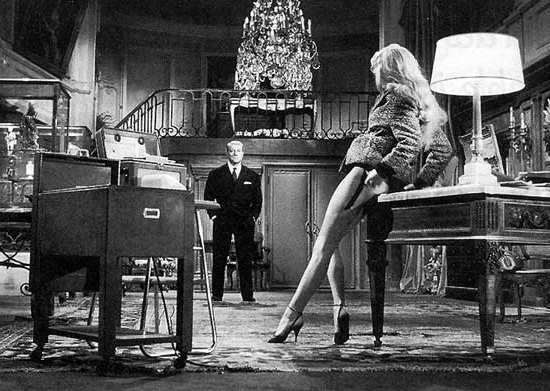
By the time Simenon's 1956 novel En cas de malheur was filmed, in 1958, 30 of the author's books had been adapted for cinema (only about a third of them Maigrets). Starring Jean Gabin opposite Brigitte Bardot, the film - whose title was translated as Love is My Profession - caused a stir for its nude scenes (pictured below), and is a good deal racier than another version 40 years later with Gérard Lanvin and Virginie Ledoyen, En plain coeur (In All Innocence), directed by Pierre Jolivet - Luc Besson's collaborator on Le dernier combat (1983).

Typically for one of Simenon's romans durs, En cas de malheur (In Case of Emergency) is written in the first person, as a married lawyer, maître Gobillot/Farnese, reflects on his affair with a young criminal; both films begin with the bungled jewellery store robbery that throws Yvette/Cecile (the names are updated for the more recent film) in his path. Aware she's about to be arrested for the crime, in both films Yvette pulls up her skirt to try to entice the lawyer to take her case (Bardot and Gabin, pictured top), though the scene is much more explicit in the book: 'She wore no pants. That was the first time I saw her thin thighs, her rounded childish belly, the dark triangle below it, and for no precise reason the blood rushed to my head.'

From then on, the 1958 film is surprisingly explicit: the first time he visits her, he comes too soon; once established in lodgings by Gobillot, Yvette institutes a ménage with her maid - a situation familiar from Simenon's own domestic life, where one maid is said to have asked another, 'On passe toutes à la casserole?' - both scenes are dropped in the 1998 version. (The maid in Claude Autant-Lara's original film is played by Nicole Berger, a beguiling presence who starred in an early Eric Rohmer short but died in a car crash aged only 32.) Yvette may be doing her best to keep Gobillot's interest alive, but there's surely also a hint of a lesbian aspect to her relationships with female accomplices and flatmates.

Jolivet's version is much less sophisticated than its predecessor: Gobillot's childlessness is highlighted in an awkward scene where his wife (Carole Bouquet) receives some adoption documents; and while Bouquet's role is more conventional, in the 1958 version, Edwige Feuillère portrays the same character as her husband's equal, who humours - even encourages - his affairs until they get out of hand. There's a lovely scene where Feuillère nevertheless hides her glasses quickly from her husband; one of that film's best images sees her flinging a giant bouquet of flowers meant for the mistress all over her husband's desk in the apartment that also serves as his office, a detail taken straight from the book. (The set up of their bedrooms, connected by a shared bathroom, is also pure Simenon.)

Where the 1998 film struggles most is in the portrayal of the lawyer: he is not supposed to be jealous when Yvette reignites an affair with someone of her own age - only Gabin can carry off Gobillot's knowing, stubborn insouciance. He's helped by some great lines and the 1958 film has some other nice touches, including the Middle Eastern music that blares in the miserable hotel where Yvette's young lover lives. The two films have completely opposing finales and yet, being Simenon, the outcome is the same - but only one ends with a haunting shot worthy of Casablanca's close.

Related: the lure of Psycho's opening scene

Wednesday, 21 September 2011

Gabin and Simenon - partners in crime

Below is a version of a piece I did to accompany French film channel Cinémoi's Jean Gabin season that I've rewritten to include more of the actor's roles in films based upon novels by Georges Simenon.

Jean Gabin was born in Paris in 1904, the son of cabaret performers; he made his way in music hall before cementing his big-screen reputation in the 1930s. He appeared alongside Josephine Baker in Zouzou (1934), was on the run in Algier’s Casbah in Pépé le Moko (1937) and then appeared in a remarkable trio of films in only two years: Marcel Carné’s Le Quai des brumes (1938), Jean Renoir’s visceral Zola adaptation La Bête humaine (same date), and Le jour se lève (1939), again with Carné.

During the war he went to the United States, where he pursued an affair with Marlene Dietrich – when Gabin insisted she be given a role in a film in which he was starring, he was sacked and joined the Free French. He was later decorated for his wartime service fighting in North Africa, and was part of the forces that entered Paris on liberation.

His 1950s citations include Jacques Becker’s classic gangster flick Touchez-pas au grisbi (1954) and the recently re-released French Cancan (Renoir, 1955). Like a more recent giant of French cinema, Gérard Depardieu, Gabin’s physical presence is unmissable but while Depardieu’s increasing girth seems to have encouraged softness in his performances, you can never exclude Gabin as a threat. His performance as a music hall impresario in French Cancan is possessed with powerful watchfulness.

It is this characteristic that made Georges Simenon’s Chief Inspector Maigret such an ideal part in a series of three films directed by Jules Delannoy and Gilles Grangier from 1958 to 1963. Gabin and Simenon were great friends but the author was especially thrilled the actor would take on the role, believing Gabin was the screen incarnation of his character (pictured).

By this time Gabin had starred in a number of films based on Simenon novels, including La Marie du port (1950), once more under Carné, La verité sur Bébé Donge (1952), with Danielle Darieux, and Le sang à la tête (1956, from the novel Le fils Cardinaud), alongside Annie Girardot.

Gabin also starred opposite Brigitte Bardot in En cas de malheur (1958), the Simenon book remade in 1998 as En plein coeur (In All Innocence) with Virginie Ledoyen and Gérard Lanvin. In 1961, Gabin was the lead in Henri Verneuil’s adaptation of Simenon’s controversial politician-in-exile novel, Le président (1961). The list gives some sense of Simenon’s cachet in the period, as well as that of Gabin.

In another Simenon adaptation, Le chat (1971), the actor stars as one half of an ageing couple whose hatred for each other is brought into the open when Gabin’s character becomes convinced his cat has been killed by his partner, played by Simone Signoret. He won Berlin’s Silver Bear award for best actor for what would turn out to be one of his last roles. Gabin died in 1976; Simenon, his elder by nearly one year, died in 1989.