Almost 20 years after the last major Edvard Munch retrospective in London - at the National Gallery - the Norwegian artist is being celebrated at Tate Modern until 14 October. The National Gallery show was based on the Frieze of Life series and the Tate exhibition also emphasises the cycles in Munch's work, more successfully than for Gerhard Richter in its recent blockbuster.
The emphasis does shift between the National Gallery and Tate shows, and not just because the former included a version of The Scream - notably from the figure of Tulla Larsen, with whom Munch had a relationship from 1899 to 1902, to Rosa Meissner, a model who came from Berlin in 1907, along with her sister, Olga. And while the exhibition at the National Gallery was preoccupied with an incident in which Munch accidentally shot himself after an argument with Tulla (presumably the source of the X-ray of a bullet in Munch's hand, which goes unexplained at the Tate), the Tate survey concentrates on an incident at a party when the artist threatened to shoot a younger artist, Ludvig Karsten.
While the National Gallery catalogue contains contemporary photographs of Munch's exhibitions, the Tate makes much more of the artist's photographs, in line with the current vogue. The main exhibit could be said to be a photograph of Rosa Meissner naked in a room, which inspired the series Weeping Woman. (Interested in auras and spiritualism - as well as blurs and odd angles - Munch creates a spooky shadow in the photo, reminiscent of Francesca Woodman's self-portraits, although the spectre is Rosa's sister, Olga.)
'Edvard Munch belongs to a generation of artists - that of Pierre Bonnard, Edouard Vuillard, Félix Vallotton... and others - all born around 1860, who achieved their first stylistic maturity in the final two decades of the nineteenth century, at the time of the great boom in amateur photography,' writes Clément Chéroux in the Tate catalogue. This overlaps with a recent exhibition, 'Snapshot: Painters and Photography, Bonnard to Vuillard', whose companion published by Easton is well worth snapping up, however: 'What fundamentally distinguishes Munch from the other painters who practised photography at the same time is the quantity of self-portraits he produced.'
Many of them are included in this exhibition; they form a sort of autobiography. While he painted himself with deliberation in such wonderful works as Between the Clock and the Bed (1940-3) - one of my favourite self-portraits of any artist - in these snaps he seems to have been looking for answers to questions he didn't know how to pose.
Though the National Gallery may have presented visitors with the broader survey of Munch's work, this great show at Tate Modern has touches of Paul Gauguin, 'who Munch considered to be the greatest artist of his time' (Arne Eggum in the Tate catalogue) - see Red Virginia Creeper (1898-1900) - and Vallotton (check out the shapes in The Kiss, 1897, or the figures in the doorway of Jealousy, 1907, inspired by Munch's unhappy relationship with Tulla Larsen). His influence can even be found, more recently, in the work of another wonderful storyteller: Peter Doig - compare Ashes and Summer Night's Dream: The Voice with Doig's Echo Lake (1998) and 100 Years Ago (Carrera), 2001.
Showing posts with label Tate Modern. Show all posts
Showing posts with label Tate Modern. Show all posts
Monday, 10 September 2012


Tuesday, 10 April 2012
Neue Slowenische Kun..
On Saturday fearsome Slovenes Laibach appear at Tate Modern. The band's performance is the climax of a day of events at the gallery examining the work of the art collective of which they're part, Neue Slovenische Kunst.
In 2004, Laibach released a greatest hits compilation, Anthems, which included a booklet featuring 'essential' paintings. The accompanying sleevenotes posited their work - bombastic cover versions of such pop fodder as The Final Countdown, Life is Life and Queen's One Vision - as 'ready mades', and now they're appearing at Tate Modern, home to Marcel Duchamp's Fountain.
 The terminology shifts the accusations of fascism typically levelled at the band onto the songs themselves. The audience at the last Laibach concert I went to - supporting their album of re-versions of national anthems - was all long leather trenchcoats and sharp haircuts but was less threatening than that at other '80s electro bands' gigs I've been to, notably for Martin Gore and Heaven 17, when a fight broke out.
In 2004, Laibach released a greatest hits compilation, Anthems, which included a booklet featuring 'essential' paintings. The accompanying sleevenotes posited their work - bombastic cover versions of such pop fodder as The Final Countdown, Life is Life and Queen's One Vision - as 'ready mades', and now they're appearing at Tate Modern, home to Marcel Duchamp's Fountain.

Monday, 13 December 2010
In and out of literary fashion
I'm underwhelmed by Tate Modern's Gauguin exhibition, which leaches colour from Paul's famous nudie paintings, although it does highlight a couple of novels in its wake. Featured heavily in the gallery shop is Mario Vargas Llosa's The Way to Paradise (2003), a double portrait of Gauguin and Gauguin's feminist grandmother Flora Tristan.
The book was further proof of the Peruvian writer's glowing reputation - recently confirmed with the award of the Nobel Prize for Literature, perhaps the final blow in his feud with Colombian Gabriel García Márquez. The exhibition also references W Somerset Maugham's earlier Gauguin-inspired novella, The Moon and Sixpence (1919; made into a film with the delectable George Sanders in 1942).
Once hugely popular for such titles as Of Human Bondage (adapted for cinema a few times) and The Razor's Edge (filmed with Tyrone Power and Gene Tierney in 1946), a 2006 adaptation of The Painted Veil, starring Naomi Watts and Edward Norton, did little to revive interest. While the sun may have set on Maugham, George Orwell is afforded changing reward: everyone reads Animal Farm and 1984 but continuing reissues by Penguin of his hardy back-catalogue, notably the essays, reap little attention.
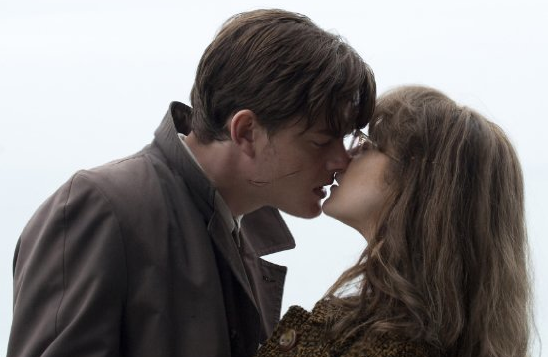
A thorough favourite at school, Graham Greene is another whose formidable oeuvre is treated with ambivalence - the legacy of jealousy over the author's contemporary popularity and prolific output or price of Britain's continuing anti-Catholic sentiment? (We can't have one as monarch; see also this last weekend's Wikileaks revelations.) How welcome a reappraisal of The Heart of the Matter, The End of the Affair (brilliantly played by Ralph Fiennes and Julianne Moore in Neil Jordan's 1999 movie), Our Man in Havana and the rest, ahead of Rowan Joffe's adaptation of Brighton Rock (pictured), starring Sam Riley (Control) and Andrea Riseborough, due out 4 February.
Wednesday, 1 December 2010
Feels like the Richter groove
'You need more than/ the Gerhard Richter hanging on your wall' - Pet Shop Boys, Love etc
The first time I knowingly saw work by German artist Gerhard Richter was MoMA's major retrospective in New York in 2002. It was a special trip: I think it was the first time my then girlfriend had been to the United States, and we saw this. As writer Geoff Dyer says elsewhere, and slightly differently, it was as if these paintings had always been waiting for me.
I love Richter's early paintings from photographs, and even his painted photographs, though equivocate on his bright lines and the like (adapted by designer Farrow for the cover of Pet Shop Boys' last album, Yes, which includes the line quoted top). In the last few years there have been a couple of major exhibitions of Richter's work in this country, including Portraits at the National Portrait Gallery in London, the Whitechapel Gallery's Atlas and his Paintings from Private Collections at the National Gallery of Scotland, Edinburgh.
Gerhard Richter: Panorama promises to be the first major retrospective of the artist in London for 20 years; let's hope its power hasn't been dissipated by these other recent displays. Before then - arriving 19 January 2011 - Tate Modern hosts Gabriel Orozco. I've seen the show in Paris and it's a zinger, up there with the venue's Cildo Meireles exhibition in winter 2008/9, and Francis Alys this past summer.
The first time I knowingly saw work by German artist Gerhard Richter was MoMA's major retrospective in New York in 2002. It was a special trip: I think it was the first time my then girlfriend had been to the United States, and we saw this. As writer Geoff Dyer says elsewhere, and slightly differently, it was as if these paintings had always been waiting for me.
I love Richter's early paintings from photographs, and even his painted photographs, though equivocate on his bright lines and the like (adapted by designer Farrow for the cover of Pet Shop Boys' last album, Yes, which includes the line quoted top). In the last few years there have been a couple of major exhibitions of Richter's work in this country, including Portraits at the National Portrait Gallery in London, the Whitechapel Gallery's Atlas and his Paintings from Private Collections at the National Gallery of Scotland, Edinburgh.
Gerhard Richter: Panorama promises to be the first major retrospective of the artist in London for 20 years; let's hope its power hasn't been dissipated by these other recent displays. Before then - arriving 19 January 2011 - Tate Modern hosts Gabriel Orozco. I've seen the show in Paris and it's a zinger, up there with the venue's Cildo Meireles exhibition in winter 2008/9, and Francis Alys this past summer.
Sunday, 10 October 2010
Photography with a bang: Muybridge and Sambourne's model behaviour

'Good evening major, my name is Muybridge and here is the answer to the letter you sent my wife.'
London is good to its perverts and, in the case of Eadweard Muybridge, its cuckolded murderers, too. Muybridge (1830- 1904) is celebrated at Tate Britain until 16 January 2011 with an excellent exhibition which has only one flaw: the fêted photographer is more showman than artist. If anything, with his frame-by-frame photographs of a (clothed) woman leaping over a stool, a cockatoo on the wing or the famous flying horse, he's a pioneering filmmaker.
Amid the equine flights of fancy there are pictures of semi-clad men running, wrestling and performing acrobatics but the exhibition is shy about Muybridge's women models, including Catherine Aimer, Kate Larrigan and Blanche Epler, a particular favourite. They're pictured - naked - stepping across wet stones, walking downstairs (apparently an inspiration for Marcel Duchamp's Nude Descending a Staircase, No 2), acting coy ('Ashamed'), getting into bed or putting their feet up for a smoke (it probably was a tiring day in the studio).
As you leave, a final caption is desperate to make a case for Muybridge's fascination with capturing falling water: in this case being tipped over one nude woman by another. There has to be a feeling that, salesman that he was, Muybridge knew his market, even if it was only him.
Beyond Tate Britain, Muybridge is currently being celebrated in his birthplace, Kingston upon Thames. It reminds me of the Royal Borough of Kensington and Chelsea's meticulous commemoration of another 19th-century photographer at the lovely Leighton House almost a decade ago.
Edward Linley Sambourne (1844-1910) was Punch's chief cartoonist who, under the pretence of needing images upon which to base his drawings - perhaps like those claiming to advance science and photography - accumulated an impressive portfolio of naked women in all sorts of mundane poses. His many models included 16-year-old Kate Manning, sisters Hetty and Lily Pettigrew, Ethel Warwick, Kate Derben, her Kennington neighbour Mrs Madge King, 'M Reid' - another favourite - and Maud Easton, of whom the most erotically charged photos were taken.
Sambourne's photo Maid sleeping in the top room at 18 Stafford Terrace (detail, pictured) would not have gone amiss in Tate Modern's recent mishit, Exposed: Voyeurism, Surveillance & the Camera, and may have been a better fit than most of the more well-known images crowbarred into that exhibition's flimsy theses. By 1905, Sambourne eschewed models for covert snaps of local schoolgirls - taken with a camera which took pictures at a right angle to the direction in which it was pointed.
- The quote at the top is said to have been spoken by Muybridge moments before he shot his young wife's lover, Major Harry Larkins. Muybridge was acquitted of murder.
Tuesday, 5 October 2010
An unflinching eye: Georges Simenon's photography
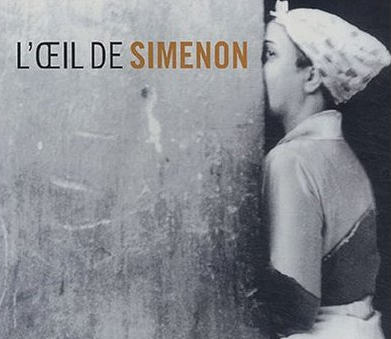 While I was in Paris I was lucky enough to stumble across the catalogue for an exhibition of photographs by writer Georges Simenon. It's beautifully reproduced so, as with many photography shows, I don't feel too badly to have missed the original event, which was held at the Jeu de Paume back in the spring of 2004.
 The prurient side of you might like to see pictures of some of the 10,000 women he claimed to have slept with - and the book's cover sneakily alludes to that (pictured) - but this is a rather splendid collection of travel photos, held by the University of Liège's centre for Simenon studies. The pictures are taken over only a few years (1931-5) but cover a wealth of locations, from north and eastern Europe to Africa and north America.
Some are unavoidably snapshots - they can be of dubious quality - but many are very beautiful; as exacting as Simenon was with words, he seems to have had quite an eye. Pictures from Sudan and the Congo are reminiscent of old National Geographic spreads (bare-breasted women with young children tied to their backs, or bathing), and predate Leni Riefenstahl's similar ethnographic work, but his images of people in Poland and Russia match those of Sergei Prokudin-Gorskii for their humanity.
Simenon's pictures of Turkey and Tunisia are especially eye-catching, while those of Tahiti capture the expat world he depicted in such novels as Banana Tourist. It makes for a bleaker take than that of painter Paul Gauguin, currently on show at Tate Modern. (There is one topless beauty, sitting like Ady Fidelin in Lee Miller's photo of Roland Penrose, Man Ray and Co picnicking in Mougins.)
With his love of boating, there are many (shaky) images of harbours: Honfleur, Ouistreham, Concarneau, Boulogne, Marseille… (For the curious, Simenon's wife Tigy and her maid Boule are pictured onboard - he slept with both of them.) Best of all, though, are his pictures of the homeland he left, Belgium, many of customers or staff in bars in Charleroi (almost in the style of August Sander, also exhibited at Tate Modern at the moment), eerily quiet streets in the Flanders, even a haunting torn poster of a skull wearing a gas mask in Brussels. Simply stunning.
Subscribe to:
Posts (Atom)
