
Showing posts with label Simenon. Show all posts
Showing posts with label Simenon. Show all posts
Thursday, 7 March 2019
New from the BFI


Wednesday, 17 December 2014
Merry Christmas!

Happy Christmas and all the very best for 2015!
Friday, 23 May 2014
The Maigret Circle

One of the prolific author's non-Maigret, romans durs, The Mahé Circle (cover image above) is an intriguing addition to Simenon's translated catalogue, in which the good Dr Mahé is trapped in a bleak infatuation on his recurring family holiday in Porquerolles - the island off the Côte d'Azur and the setting for My Friend Maigret (1949), one of the dozen or so books featured in Penguin's previous, apparently ill-fated Simenon revival back in 2003. A little down the coast, the Cannes Film Festival has hosted the premiere of Mathieu Amalric's intriguing adaptation of The Blue Room (1955), starring the actor-director alongside Stéphanie Cléau and Léa Drucker (here's the poster).
No doubt all this and more will be mulled over by biographers Pierre Assouline and Patrick Marnham when they share the stage at the Institut Français on 1 June. Their discussion follows a screening of one of my favourite Simenon adaptations, M Hire, as part of the Institut's all too short Noir is the Colour season.
Monday, 4 November 2013
Tout Maigret

Penguin has tried remarketing Simenon twice in the past decade, with limited success. In 2003, on his centenary, a series of Maigrets was published in Penguin Classics, with covers by Keenan, alongside a handful of the author's notorious romans durs (as Modern Classics). Problems with Penguin's move to a new warehouse may have been to blame at the time, and three years later some of the Maigrets were repackaged once again, this time as pocketbooks.
This is an audacious move for what may have become an acquired taste for crime connoisseurs, and Pietr the Latvian (Maigret and the Enigmatic Lett in Daphne Woodward's 1963 translation, pictured) is no bad place to start; 10 Maigrets were published in 1931 and Simenon always said this was the first to be completed. The template is established here, alongside the introduction of other favourite characters including Madame Maigret, while Simenon can investigate one of his favourite themes: identity.
The current crop is branded "Inspector Maigret" and returns to the stock cover images of the Modern Classics*; the books are more faithful to the original titles and some of the goodies that await include The Night at the Crossroads (due April 2014) and The Bar on the Seine (October 2014). The problem for many fans is whether to invest once more in these new imprints, but what a happy problem!
*UPDATE I note from the estimable Caustic Cover Critic that the cover images have been specially commissioned from Belgian photographer Harry Gruyaert. I'm not convinced by them but fair play to Penguin for their commitment and, darn it, this makes these new editions all the more collectable.
Monday, 25 March 2013
Anatomy of a film: En cas de malheur
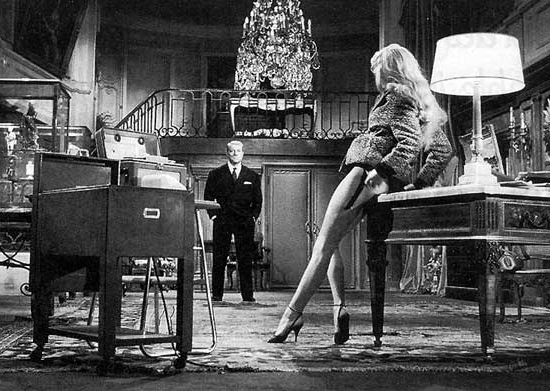
By the time Simenon's 1956 novel En cas de malheur was filmed, in 1958, 30 of the author's books had been adapted for cinema (only about a third of them Maigrets). Starring Jean Gabin opposite Brigitte Bardot, the film - whose title was translated as Love is My Profession - caused a stir for its nude scenes (pictured below), and is a good deal racier than another version 40 years later with Gérard Lanvin and Virginie Ledoyen, En plain coeur (In All Innocence), directed by Pierre Jolivet - Luc Besson's collaborator on Le dernier combat (1983).

From then on, the 1958 film is surprisingly explicit: the first time he visits her, he comes too soon; once established in lodgings by Gobillot, Yvette institutes a ménage with her maid - a situation familiar from Simenon's own domestic life, where one maid is said to have asked another, 'On passe toutes à la casserole?' - both scenes are dropped in the 1998 version. (The maid in Claude Autant-Lara's original film is played by Nicole Berger, a beguiling presence who starred in an early Eric Rohmer short but died in a car crash aged only 32.) Yvette may be doing her best to keep Gobillot's interest alive, but there's surely also a hint of a lesbian aspect to her relationships with female accomplices and flatmates.
Jolivet's version is much less sophisticated than its predecessor: Gobillot's childlessness is highlighted in an awkward scene where his wife (Carole Bouquet) receives some adoption documents; and while Bouquet's role is more conventional, in the 1958 version, Edwige Feuillère portrays the same character as her husband's equal, who humours - even encourages - his affairs until they get out of hand. There's a lovely scene where Feuillère nevertheless hides her glasses quickly from her husband; one of that film's best images sees her flinging a giant bouquet of flowers meant for the mistress all over her husband's desk in the apartment that also serves as his office, a detail taken straight from the book. (The set up of their bedrooms, connected by a shared bathroom, is also pure Simenon.)
Where the 1998 film struggles most is in the portrayal of the lawyer: he is not supposed to be jealous when Yvette reignites an affair with someone of her own age - only Gabin can carry off Gobillot's knowing, stubborn insouciance. He's helped by some great lines and the 1958 film has some other nice touches, including the Middle Eastern music that blares in the miserable hotel where Yvette's young lover lives. The two films have completely opposing finales and yet, being Simenon, the outcome is the same - but only one ends with a haunting shot worthy of Casablanca's close.
Related: the lure of Psycho's opening scene
Wednesday, 13 February 2013
Happy 110th birthday, Georges!
This year marks the 110th anniversary of the birth of one of Liège's most famous sons, author Georges Simenon. What better way to pay homage than a short walk around the major sites of his young life in the southern Belgian city.
Start at 24 (formerly 26) rue Léopold, where Georges was born on a rainy night. He is famously said to have been born on Friday the 13th, 1903, but his superstitious mother insisted that his father register the date of birth as the 12th.
On the wall in front of the nearby Hôtel de Ville, on the Place du Marché, check out the memorial plaque to Commissaire Arnold Maigret, whose surname may have been appropriated for Simenon's greatest creation: Chief Inspector Jules... Simenon will no doubt have been aware of the real Maigret when he started work as a young reporter on the Gazette de Liège newspaper.
From here cross over to quirky Outremeuse, over the Pont des Arches - the title of Simenon's first novel - via the Eglise St-Pholien, which became the inspiration for another early book when his friend Kleine was found hanged from the front door.
Behind the St-Pholien church, on Impasse de la Houpe, the infamous group La Caque ('the keg') - named for its cramped circumstances - hung out, indulging in drink, drugs and sex. I'm tickled by the pride the town takes in Simenon's experience on rue Capitaine, where the man who later claimed to have bedded 10,000 women handed over a watch he had been given by his father to sleep with a prostitute.
The island of Outremeuse has a strange, otherworldly reputation in Liège's folklore and the family moved here a year after Georges was born. The atmosphere of the house in the rue de la Loi, next door to Georges's school, permeates much of Simenon's work, from the autobiographical Pedigree to one of the most famous romans durs, Stain in the Snow.
If you continue to the place du Congrès, you'll spot a bust of Simenon, not far from the Chapelle de Bavière, where young Georges served as an altar boy. He would have to leave home at 5.45am, arriving out of breath as he ran, frightened, all the way in the dark.
Running away is the a central theme of all Simenon's work and he, too, left the city, following the deaths of his father and Joseph Kleine. On 10 December 1922 he took the night train to Paris, the city where he would plot his fame and fortune.
You can hire an audioguide to Simenon's Liège for €4.50 at the local tourist office, which also provides a map of the route.
Related post: Simenon's Paris
Start at 24 (formerly 26) rue Léopold, where Georges was born on a rainy night. He is famously said to have been born on Friday the 13th, 1903, but his superstitious mother insisted that his father register the date of birth as the 12th.
On the wall in front of the nearby Hôtel de Ville, on the Place du Marché, check out the memorial plaque to Commissaire Arnold Maigret, whose surname may have been appropriated for Simenon's greatest creation: Chief Inspector Jules... Simenon will no doubt have been aware of the real Maigret when he started work as a young reporter on the Gazette de Liège newspaper.
From here cross over to quirky Outremeuse, over the Pont des Arches - the title of Simenon's first novel - via the Eglise St-Pholien, which became the inspiration for another early book when his friend Kleine was found hanged from the front door.
Behind the St-Pholien church, on Impasse de la Houpe, the infamous group La Caque ('the keg') - named for its cramped circumstances - hung out, indulging in drink, drugs and sex. I'm tickled by the pride the town takes in Simenon's experience on rue Capitaine, where the man who later claimed to have bedded 10,000 women handed over a watch he had been given by his father to sleep with a prostitute.
The island of Outremeuse has a strange, otherworldly reputation in Liège's folklore and the family moved here a year after Georges was born. The atmosphere of the house in the rue de la Loi, next door to Georges's school, permeates much of Simenon's work, from the autobiographical Pedigree to one of the most famous romans durs, Stain in the Snow.
If you continue to the place du Congrès, you'll spot a bust of Simenon, not far from the Chapelle de Bavière, where young Georges served as an altar boy. He would have to leave home at 5.45am, arriving out of breath as he ran, frightened, all the way in the dark.
Running away is the a central theme of all Simenon's work and he, too, left the city, following the deaths of his father and Joseph Kleine. On 10 December 1922 he took the night train to Paris, the city where he would plot his fame and fortune.
You can hire an audioguide to Simenon's Liège for €4.50 at the local tourist office, which also provides a map of the route.
Related post: Simenon's Paris
Monday, 2 July 2012
About the author
In these days of brisk author biographies, it's a pleasure to discover the - presumably self-composed - details of Janwillem van de Wetering published in his Soho Crime works. Born in Rotterdam in 1931, we're informed, the writer studied 'Zen in Daitoku-ji monastery, Kyoto, and philosophy in London, and has lived as well in Amsterdam, Cornwall, Cape Town, Bogota, Lima and Brisbane.'
There's a reassurance as to the books' provenance: 'His Amsterdam Cops series that features Adjutant Grijpstra and Sergeant de Gier... was conceived when the author served with the Amsterdam Reserve Constabulary.' And fun, too: 'His joys are an ongoing study of nihilism, keeping a wooden lobster boat afloat and getting older.'
Georges Simenon's biographies on the back of old Penguins also acknowledge the great crime writer's boating activities: 'He has travelled all over the world, and at one time lived in a cutter, with his wife as second-in-command, making long journeys of exploration round the coasts of northern Europe.' I particularly like the line: 'His recreations are riding, fishing and golf.'
My favourite biography, however, has to be that for Giovanni Guareschi (again in Penguin); 'His father had a heavy black moustache under his nose: Giovanni grew one just like it. He still has it and is proud of it. He is not bald, has written eight books, and is five feet ten inches tall.
'"I also have a brother," Guareschi says, adding "but I prefer not to discuss him. And I have a motorcycle with four cylinders, an automobile with six cylinders, and a wife and two children."' Now don't you want to read his Don Camillo series of books? You should!
There's a reassurance as to the books' provenance: 'His Amsterdam Cops series that features Adjutant Grijpstra and Sergeant de Gier... was conceived when the author served with the Amsterdam Reserve Constabulary.' And fun, too: 'His joys are an ongoing study of nihilism, keeping a wooden lobster boat afloat and getting older.'
Georges Simenon's biographies on the back of old Penguins also acknowledge the great crime writer's boating activities: 'He has travelled all over the world, and at one time lived in a cutter, with his wife as second-in-command, making long journeys of exploration round the coasts of northern Europe.' I particularly like the line: 'His recreations are riding, fishing and golf.'
My favourite biography, however, has to be that for Giovanni Guareschi (again in Penguin); 'His father had a heavy black moustache under his nose: Giovanni grew one just like it. He still has it and is proud of it. He is not bald, has written eight books, and is five feet ten inches tall.
'"I also have a brother," Guareschi says, adding "but I prefer not to discuss him. And I have a motorcycle with four cylinders, an automobile with six cylinders, and a wife and two children."' Now don't you want to read his Don Camillo series of books? You should!
Wednesday, 18 January 2012
Stitches in time: the tailor in fiction
It's with creeping inevitably that I pick up from last week's post and the reference to Louis Garrel's short The Little Tailor to search out further tailors in fiction, starting with The Tailor of Panama. John le Carré's 1996 novel, inspired by Graham Greene's Our Man in Havana, was filmed in 2001, providing a star turn - and a break from Bond - for Pierce Brosnan.
Brosnan's character has been discarded by MI6 in Panama, where he leans on Geoffrey Rush's tailor to find a way to secure his return to the fold. This tailor is typical of what we come to expect in screen depictions of the type: grasping, out-of-his-depth, a little bit sleazy.
The archetype is, of course, described by Georges Simenon in Les Fiançailles de Monsieur Hire (1933), filmed by Patrice Leconte in one of my favourite adaptations of the Belgian author's work. Michel Blanc stars as the eponymous M Hire, who spies on his beautiful neighbour, played by Sandrine Bonnaire, and is incriminated in the killing of another young woman nearby. In Anna Moschovakis' translation (for the 2007 NYRB edition), '... one sensed in him neither flesh nor bone, nothing but soft, flaccid matter, so soft and so flaccid that his movements were hard to make out.'
Like Simenon's tailor, Garrel's is Jewish and, as the young director noted, anachronistic. (I like, too, Garrel's admission that he tried to make a longer, feature, film but he cut and cut, and was left with 45 minutes.) For timeless tailors who have given us a byword for cutting down pretension we look to Hans Christian Andersen's swindlers, who pose as weavers in The Emperor's New Clothes (1837).
But my favourite fictional tailors come in Rohinton Mistry's wondrous A Fine Balance (1995), starting with unfortunate young widow Dina Shroff, who is encouraged to set up her own tailoring business to maintain her independence. She hires villagers Ishvar and his nephew Om and makes a quilt from the workers' scraps.
Later on it evokes memories of their time together '... that's the rule to remember, the whole quilt is much more important than any single square.' And there is a gap, yet to be completed: 'Before you can name that corner,' continues Ishvar, 'our future must become past.'
It is also a book of the city, Mumbai, which I don't think is ever named. After another adventure the tailors return to their favoured haunt, the Vishram restaurant:
'You fellows are amazing,' the sweaty cook roared over the stoves. 'Everything happens to you only. Each time you come here, you have a new adventure story to entertain us.'
'It's not us, it's the city,' said Om. 'A story factory, that's what it is, a spinning mill.'
Wednesday, 4 January 2012
New year at Ciné lumière
For a single-screen rep cinema, Ciné lumière can boast much imaginative programming, such as a season of Spirituality in Cinema to accompany the release of Xavier Beauvois' Of Gods and Men (2010) and Palme d'Or winner Uncle Boonmee Can Recall His Past Lives. Perhaps inspired by The Iron Lady, which opens there this Friday, the South Ken institute launches a series of films about government.
The Corridors of Power season kicks off on Sunday with lengthy De Gaulle biopic, Le Grand Charles, from 2005. Current fare includes The Conquest, again starring Denis Podalydès - this time about Sarkozy's rise to the French presidency - L'exercice de l'etat, with Michel Blanc, and Alain Cavalier's Pater, starring Cavalier and Vincent Lindon.
Two classics of the last decade also feature: The Last Mitterand (2004) - which won Blanc won a César for his portrayal of François Miterrrand - and 1974: une partie de campagne (2001), Raymond Depardon's Giscard d'Estaing doc. There's no place for powerful Georges Simenon adaptation The President (1961), starring Jean Gabin and Bernard Blier, presumably because a subtitled print isn't available. Simenon fans will, however, be tempted separately by Maigret's Mistake (1994), a feature-length episode of the French TV series starring Bruno Cremer.
The highlight of this month's programme focuses on TV: Totally Serialized, a celebration of French and British small-screen offerings on the big screen, runs 19-22 January. Alongside an all-night Misfits marathon (on Saturday 21 January), there's a free screening of an episode of Elite Squad the next morning, a script-writing workshop attended by Frank Spotnitz (The X-Files) and Eric de Barahir (Spiral) among others, plus the first episode of This is England '88 followed by a Q&A with the cast. I'd also pick out a screening of the opening episode of gritty cop series Braquo (22 January) attended by director Olivier Marchal and star Jean Hugues Anglade (Betty Blue, Subway).
Tuesday, 4 October 2011
Simenon through the eyes of others
BELGIUM MONTH
I've written before about film adaptations of Georges Simenon's books, the Belgian author's photographs and the Paris of his most famous character, Maigret. Simenon's oeuvre was hugely admired by André Gide and François Mauriac among others, and for this post I thought I'd round up the thoughts of some other writers from different generations and backgrounds on his prolific talent.
Julian Barnes's essay on Simenon, The Pouncer, included in the British novelist's Francophile collection Something to Declare, starts predictably enough, with a numerical rundown: 'The 400-plus books he wrote; the 55 cinema and 279 television films made from them; the 500 million copies sold in 55 languages...' - intriguing Barnes contemplates the adaptations ahead of sales and the translations - and, of course, Simenon's 'famous estimate of having bedded 10,000 women.'
This is a critique of Patrick Marnham's biography of Simenon for the Literary Review and only in passing do we get a sense of what Barnes admires in the subject: 'One of the distinctions of the fiction, especially of the romans durs, is to show sympathetic understanding for driven, obsessed, morally affectless characters who inflict and sustain often terrible damage. The refusal to moralize makes them less distant, less safely other.'
For sheer enthusiasm, we turn to Simenon's contemporary, Anais Nin, who writes in the summer of 1955: 'I study the style of Simenon because he is a master in the physical world... Simenon has always selected the characters who submitted to destiny, a destiny formed by their character...' She is great at summing up his work in The Journals of Anais Nin, Volume Five 1947-1955: 'The tone is always fatalistic, joyless, and the characters are victims of their own suicidal destructiveness. He has described all possible variations on destruction and self-destruction.'
In the winter of 1948, Nin writes: 'Simenon. The pattern is the same in every book. It is the fall of man. Simenon is aware that this fall is caused by the fatality of an impulse of self-destruction more often than by external fatality.'
If this all sounds depressing, a few months later she states: 'He is my favourite storyteller. He has a good story to tell, and he works subtly at charaterisation. His characters are beautifully wrought, his details significant... People do not appreciate his novels as they should because he made his reputation writing detective novels.'
Writer John Raymond tackles this last point in his critical biography from 1968, Simenon in Court: 'If [the study] helps to serve public notice of an achievement far greater than Simenon's average readers have realised or perhaps supposed even, it will have achieved its purpose...' Its clunky title notwithstanding, the book falters on Raymond's judgement of the works. (I'm thinking particularly of his contradictory dismissal of Inquest on Bouvet, towards which I've always been partial.)
Raymond is at his most poetic on the criminal protagonist of 1941's Justice (Cours d'Assises), Petit-Louis: 'Of all Simenon's unfortunates, he is perhaps the most human because he is the weakest and most alone.' I'll leave the final tribute to Nin, however: 'He is perhaps our best psychologist in the novel.'
Georges Simenon is the subject of the inaugural exhibition at Brussels' new Museum of Letters and Manuscripts, until 24 February 2012.
Wednesday, 21 September 2011
Gabin and Simenon - partners in crime

Below is a version of a piece I did to accompany French film channel Cinémoi's Jean Gabin season that I've rewritten to include more of the actor's roles in films based upon novels by Georges Simenon.
Jean Gabin was born in Paris in 1904, the son of cabaret performers; he made his way in music hall before cementing his big-screen reputation in the 1930s. He appeared alongside Josephine Baker in Zouzou (1934), was on the run in Algier’s Casbah in Pépé le Moko (1937) and then appeared in a remarkable trio of films in only two years: Marcel Carné’s Le Quai des brumes (1938), Jean Renoir’s visceral Zola adaptation La Bête humaine (same date), and Le jour se lève (1939), again with Carné.
During the war he went to the United States, where he pursued an affair with Marlene Dietrich – when Gabin insisted she be given a role in a film in which he was starring, he was sacked and joined the Free French. He was later decorated for his wartime service fighting in North Africa, and was part of the forces that entered Paris on liberation.
His 1950s citations include Jacques Becker’s classic gangster flick Touchez-pas au grisbi (1954) and the recently re-released French Cancan (Renoir, 1955). Like a more recent giant of French cinema, Gérard Depardieu, Gabin’s physical presence is unmissable but while Depardieu’s increasing girth seems to have encouraged softness in his performances, you can never exclude Gabin as a threat. His performance as a music hall impresario in French Cancan is possessed with powerful watchfulness.
It is this characteristic that made Georges Simenon’s Chief Inspector Maigret such an ideal part in a series of three films directed by Jules Delannoy and Gilles Grangier from 1958 to 1963. Gabin and Simenon were great friends but the author was especially thrilled the actor would take on the role, believing Gabin was the screen incarnation of his character (pictured).
By this time Gabin had starred in a number of films based on Simenon novels, including La Marie du port (1950), once more under Carné, La verité sur Bébé Donge (1952), with Danielle Darieux, and Le sang à la tête (1956, from the novel Le fils Cardinaud), alongside Annie Girardot.
Gabin also starred opposite Brigitte Bardot in En cas de malheur (1958), the Simenon book remade in 1998 as En plein coeur (In All Innocence) with Virginie Ledoyen and Gérard Lanvin. In 1961, Gabin was the lead in Henri Verneuil’s adaptation of Simenon’s controversial politician-in-exile novel, Le président (1961). The list gives some sense of Simenon’s cachet in the period, as well as that of Gabin.
In another Simenon adaptation, Le chat (1971), the actor stars as one half of an ageing couple whose hatred for each other is brought into the open when Gabin’s character becomes convinced his cat has been killed by his partner, played by Simone Signoret. He won Berlin’s Silver Bear award for best actor for what would turn out to be one of his last roles. Gabin died in 1976; Simenon, his elder by nearly one year, died in 1989.
Wednesday, 6 April 2011
Armless fun or, the cricketing kings of limb
A post of five unknown London pleasures on the great Great Wen blog recently piqued my interest. In it Peter Watts notes, 'in 1796, Montpelier Gardens in Walworth hosted a cricket match between 11 one-armed Greenwich pensioners and 11 one-legged Greenwich pensioners. Interest was so great that a fence was broken and spectators fell through a stable roof.' The scorecard is here.
Pete kindly sent me links to a couple more such matches: one between wounded army veterans at the Oval in 1862 - 'One Arm v One Leg', as the poster advertises - and another from 1858.
Then there is this on a South African site about an 1861 match between 11 one-armed and 11 one-legged men played at 11am in Peckham Rye. 'The players... played more like madmen than sober rational cricketers,' says the correspondent, who marvels at their lack of protective wear. 'What is a blow on the knuckles to a man who has lost an arm or a leg, who has felt the surgeon's saw and the keen double-edged knife?...
'Well, I suppose the fact is, that men don't think much of misfortunes when they are once irretrievable, and that these men felt a pleasure in doing an eccentric thing, in showing how bravely and easily they could overcome an infirmity that to some men appears terrible. After all, one thinks, after seeing such a game, one-legged and one-armed men are not so miserable as people imagine.'
It's a wonderful report, with beer and the heat adding to the 'Holbeinish fun'. And the outcome? Ultimately, 'the one-legs could not get at the ball quickly enough, their fielding was not first rate, the one arms made a gigantic effort... and won.'
POSTSCRIPT You won't be surprised to learn that a much darker literary take on this physical juxtaposition comes in a Georges Simenon novel: The Door (1962). In this remorseless portrait of jealousy, Bernard, whose hands were blown off by a mine, lives happily with his beautiful wife, Nelly, until he becomes convinced she is having an affair with their new downstairs neighbour - who is confined to a wheelchair. To say the outcome is bleak hardly covers it.
Tuesday, 29 March 2011
Ghote guy
 I've never been sure of the success of Penguin's accession of Georges Simenon into its Modern Classics field. Certainly it raised the Belgian author's profile for a new generation of crime fans, as well as providing us with some great covers, but the lack of reprints might lead you to conclude that the reissues were less popular than was envisaged. (It may have been a case of bad timing, I think Penguin changed over its old ordering system when the Simenons were reprinted.)
 Let's hope a similar fate doesn't befall the upcoming canonisation of four of HRF Keating's Inspector Ghote mysteries. Created in the 1960s, the books conjure a Bombay the author, who died on Saturday aged 84, didn't visit until he wrote the tenth in the series (of 24). The language is especially atmospheric, from such words as 'dacoit' - still in use today - to the repetitive rhyming of character Arun Varde in the first work, The Perfect Murder.
In his new introduction to that book, Alexander McCall Smith states: 'Ghote himself is one of the great creations of detective fiction. Unlike many fictional detectives, who are often outsiders, possessed in many cases of personal demons, Ghote is utterly loveable.' The new editions are published next week, on 7 April, and there could hardly be a more fitting tribute.
Thursday, 27 January 2011
Five notable film performances by male French pop stars

1. Charles Aznavour, Shoot the Pianist (1960)
Cast in more than 70 features, Aznavour's most memorable turn is as the lead in François Truffaut's adaptation of the novel by David Goodis, Down There, which screens at the BFI Southbank 3 and 4 February. The son of Armenian immigrants to France, Aznavour's quiet, wounded looks make him an ideal fit, too, for a Simenon adaptation and, sure enough, he starred as Kachoudas in Claude Chabrol's Les fantomes du chapelier (1982).
2. Jacques Dutronc, Van Gogh (1991)
He has appeared alongside Isabelle Huppert in both Jean-Luc Godard's Slow Motion (1980) and Claude Chabrol's Merci pour le chocolat (2000) but his stand-out performance came in Maurice Pialat's Van Gogh. Dutronc, pictured top, won a Best Actor César for his performance of the artist during his final days.
3. Johnny Halliday, L'homme du train (2002)
The Belgian-born giant of French rock music is credited with an early role in Henri-Georges Clouzot's Les diaboliques (1955), rising to Jean-Luc Godard's Détective in 1984. His stand-out performance, for which he won the prix Jean Gabin, came in Patrice Leconte's doleful feature as a gangster on the run who finds himself holed up with a retired French teacher, played by Jean Rochefort.
4. Eddy Mitchell, Until the End of the World (1991)
The hulking Mitchell has appeared in Bertrand Tavernier's Coup de Tourchon (1981), an adaptation of a Jim Thompson novel, and Etienne Chatiliez' Le bonheur est dans le pré (1995). He is probably best known to international audiences for his role as a gangster on the run with hapless sidekick Chick Ortega in Wim Wenders' rambling intercontinental road movie.
5. Patrick Bruel, Force majeure (1989)
Bruel topped the bill for this film by Pierre Jolivet alongside François Cluzet (Tell No One); he's also starred with Dutronc in Toutes peines confondues (1992), directed by Michel Deville (La lectrice, Death in a French Garden). Otherwise Bruel tends to be a staple of urban comedy dramas among an ensemble cast, for instance 2009's Le code a changé, with Karin Viard, Dany Boon, Emmanuelle Seigner and Marina Hands. Wiki notes he is also a professional poker player.
Because no round-up of French music is complete without a namecheck for Serge Gainsbourg, I should mention the mindbending videos that accompany his Histoire de Melody Nelson concept album. Gainsbourg's reticence to appear in more features may be explained by his antipathy towards his looks, a hook Joann Sfarr exploited for his recent biopic about the musician, but there's always his lead in the self-directed and self-scripted Charlotte for Ever (1986) as an alcoholic scriptwriter, father to real-life daughter Charlotte.
Related: French actresses with one-word names.
Tuesday, 5 October 2010
An unflinching eye: Georges Simenon's photography
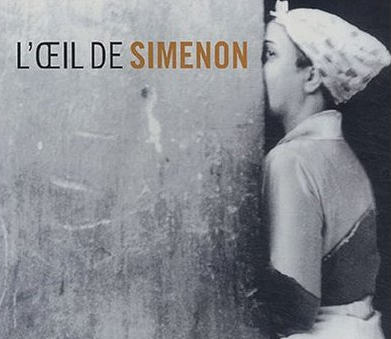 While I was in Paris I was lucky enough to stumble across the catalogue for an exhibition of photographs by writer Georges Simenon. It's beautifully reproduced so, as with many photography shows, I don't feel too badly to have missed the original event, which was held at the Jeu de Paume back in the spring of 2004.
 The prurient side of you might like to see pictures of some of the 10,000 women he claimed to have slept with - and the book's cover sneakily alludes to that (pictured) - but this is a rather splendid collection of travel photos, held by the University of Liège's centre for Simenon studies. The pictures are taken over only a few years (1931-5) but cover a wealth of locations, from north and eastern Europe to Africa and north America.
Some are unavoidably snapshots - they can be of dubious quality - but many are very beautiful; as exacting as Simenon was with words, he seems to have had quite an eye. Pictures from Sudan and the Congo are reminiscent of old National Geographic spreads (bare-breasted women with young children tied to their backs, or bathing), and predate Leni Riefenstahl's similar ethnographic work, but his images of people in Poland and Russia match those of Sergei Prokudin-Gorskii for their humanity.
Simenon's pictures of Turkey and Tunisia are especially eye-catching, while those of Tahiti capture the expat world he depicted in such novels as Banana Tourist. It makes for a bleaker take than that of painter Paul Gauguin, currently on show at Tate Modern. (There is one topless beauty, sitting like Ady Fidelin in Lee Miller's photo of Roland Penrose, Man Ray and Co picnicking in Mougins.)
With his love of boating, there are many (shaky) images of harbours: Honfleur, Ouistreham, Concarneau, Boulogne, Marseille… (For the curious, Simenon's wife Tigy and her maid Boule are pictured onboard - he slept with both of them.) Best of all, though, are his pictures of the homeland he left, Belgium, many of customers or staff in bars in Charleroi (almost in the style of August Sander, also exhibited at Tate Modern at the moment), eerily quiet streets in the Flanders, even a haunting torn poster of a skull wearing a gas mask in Brussels. Simply stunning.
Monday, 13 September 2010
Maigret's Paris: a walk
Georges Simenon's books, as I've noted before, are so thick with atmosphere they almost serve in their own right as guides to the cities in which they're set. He's best on Paris, most notably in the novels dedicated to Chief Inspector Maigret. It would be the work of a lifetime to plot the locations from his books - and many are long gone, of course - but a few obvious sites stand out.

Start at 36 Quai des Orfèvres, the headquarters of the Police Judiciare and Maigret's base, on the Île de la Cité. (This wonderful Life article includes a photo of Simenon climbing the stairs there, in the mould of his hero - and what great ads.) Behind it, on the Place Dauphine, is the setting for the fictional Chez Paul, the bar to which Maigret used to send for beers and sandwiches in the midst of one of his night-long interrogations.

Heading north-east is the Place des Vosges, where both Simenon (from 1924, with wife Tigy) and Maigret lived for a time, and then there's 132 Boulevard Richard Lenoir, as iconic to fans of the French detective as London's 221b Baker Street to admirers of Sherlock Holmes. A market on Thursday and Sunday mornings makes for a characteristic diversion but film-lovers may be tempted to travel a bit further, up to the Canal St Martin, setting for a scene in Jean-Pierre Jeunet's whimsical Amelie (2001), and home to Hôtel du Nord, immortalised by Marcel Carné in 1938. You'll need lunch by now, and one of the many lovely cafés round here should serve just fine.

Sunday, 20 June 2010
By Georges! Simenon on film

This blog takes its name from a 1934 Georges Simenon novel, which was made into a film by Béla Tarr a few years ago. (It was published by Penguin in Britain under the mundane title Newhaven-Dieppe.) A famously prolific author for four decades from the early 1930s, Simenon's work is still a favourite for adaptation to the big and small screens, not least thanks to his magnificent Maigret books.
Bertrand Tavernier chose to take his first film, The Watchmaker of St Paul, from a Simenon novel and is still a fan: 'I love Simenon, I think he's one of the greatest writers.' And Tavernier is someone you listen to on such matters. 'What I love in his books are things that go beyond the superficial: the mood, the fog, the wet cobblestones, dealing with what he calls the "naked man," this feeling of a man under the clothes of civilisation and society.'
This could almost be a description of Hungarian Tarr's The Man from London, which starred Tilda Swinton among a multi-accented cast. A version of one of Simenon's most famous novels, Stain in the Snow, is said to be in production. A couple of recent adaptations I'd like to see are a French TV version of The Little Man from Archangel (whose Jewish central character is replaced by an Algerian bookseller), and Mexican film La habitación azul (2002). The 1963 book it's based on (The Blue Room) begins with the image of a man contemplating his mistress, 'naked still on the ravaged bed, her legs apart, a few drops of semen clinging to the dark hair, shadowy between her thighs.'
One of my favourite adaptations from a Simenon book of the last generation is 1989's Monsieur Hire, starring a typically mournful Michel Blanc alongside the beautiful Sandrine Bonnaire. Though Simenon boasted he'd boiled his vocabulary down to 2,000 words he's surprisingly difficult to read (for the non-native French fan) in the original as he's all about atmosphere, and Patrice Leconte's stylish film reflects that.
That's one reason I'd love to see Nuri Bilge Ceylan tackle a Simenon novel. In my mind, Béla Tarr's foggy, claustrophobic The Man from London made a good pairing with his Turkish counterpart's Three Monkeys (2008). Having scripted all six of his tremendous films thus far, Ceylan is open to taking on an adapted script. 'I would like to make adaptations but it's not easy, sometimes writing yourself is easier,' he told me at the time of his previous film, Climates (2006). 'I have many novels or stories that I like but sometimes when you begin to work on it, it turns out to be more difficult. I couldn't make an adaptation yet but I want to do it some day.'
He could do worse than looking at the work of someone with whom he shares many concerns and conceits. A tasty early novel, The Window over the Way (1933), features a Turkish diplomat caught in a possible honeytrap in the Black Sea port of Batumi. Feeling under the weather, Adil Bey demands to see a doctor. 'What exactly is wrong?' he asks the physician. 'Nothing,' comes the lugubrious reply, 'and to some extent everything.'
Thursday, 7 May 2009
Furst-class travel

My favourite author for a good read on a long journey is Alan Furst, who has now written 10 spy thrillers all set in the run-up to World War II. In his latest, The Spies of Warsaw, the aristocratic hero, Jean-François Mercier, decides to take a 17-hour train trip from the Polish capital to Belgrade in the hope of meeting up with a woman he has fallen for. He takes with him a copy of Stendhal's The Red and the Black; "[Mercier] had always had an instinct for something improving, demanding, but by page 14 he gave up and brought out what he really wanted to read, a Simenon roman policier, The Bar on the Seine…"
Now Simenon is a great choice but perhaps better for when you reach your destination – and in omnibus edition – because his books are, as Mercier finds, "all too soon finished". (The Bar on the Seine is an early, very good, Maigret novel, set in the guingettes Simenon would no doubt have known from his days sailing around France with his first wife, Tigy, and her maid, Boule, who was also his lover.)
In his latest book, Nothing to be Frightened Of, Julian Barnes admits that as a young man he, like Mercier, used to carry an impressive book with him, though in different circumstances – Barnes was terrified of flying; "The book I would choose to read on a plane would be something I felt appropriate to have found on my corpse. I remember taking Bouvard et Pécuchet on a flight from London to Paris, deluding myself that after the inevitable crash a) there would be an identifiable body on which it might be found; b) that Flaubert in French paperback would survive impact and flames; c) that when recovered, it would still be grasped in my miraculously surviving (if perhaps severed) hand…"
Perhaps I am a reverse snob and happy to be caught reading a good thriller; certainly, if I am found in a crash clasping the latest Alan Furst, at least you can count that I died happy. There is another question here, too, of reading in public, being seen to read. A gentleman on my daily commute into Waterloo gives up his seat every morning to women passengers (never men) and is always grasping CS Lewis on Christianity (the same book for months); I can only assume this is some sort of pose. (And then there are those books you don't want to be seen reading: the Traveller's Companion Series of books were essentially pornographic novels published by the infamous Olympia Press within plain green covers.)
I've always found Arturo Pérez-Reverte reliable for a good travel read, though I haven't tried his Alatriste books yet. I can also recommend Philip Kerr for his Bernie Gunther mysteries, largely set in wartime Germany, though now going beyond; and Stieg Larsson is unmissable. It sounds as if I ought, also, try Polish crime writer Marek Krajewski who, like Kerr and Larssen, is published by Quercus – they're on quite a roll.
Sunday, 15 February 2009
A couple of film things
Following the BAFTAs, someone suggested Israeli movie Waltz With Bashir should have won the award for the best film in a foreign language, rather than I've Loved You So Long, the French drama starring a rather wonderful Kristin Scott Thomas. This could be indicative of a continuing anti-animation bias, or snobbishness, but I do think I've Loved You… is the better film. (Waltz is essentially a rather straight, personal documentary with some very beautiful artistry on top.)
I'm still bothered, however, by I've Loved You's tremendously limp, if not downright nonsensical, ending. Throughout the film I was convinced we would discover that Scott Thomas's character, Juliette, was covering for her younger sister, Léa (the equally brilliant Elsa Zilberstein), that Léa had killed Juliette's young child, and had blanked this childhood trauma from her mind. The actual ending is tremendously disappointing; a good film that needs a final kick in the tail to become a great one?
I hope the Turkish director Nuri Bilge Ceylan is up there next time with a BAFTA nomination for his typically gloomy Three Monkeys. Beautifully filmed, as ever, I hope that he will one day tackle a Simenon adaptation, he has such a knack for capturing humanity, and atmosphere. There's some lovely characterisation in Three Monkeys, and all those train whistles, creaking doors and boat horns would fit directly the world of Simenon, a world of misplaced people, looks and wishes.
Subscribe to:
Posts (Atom)
